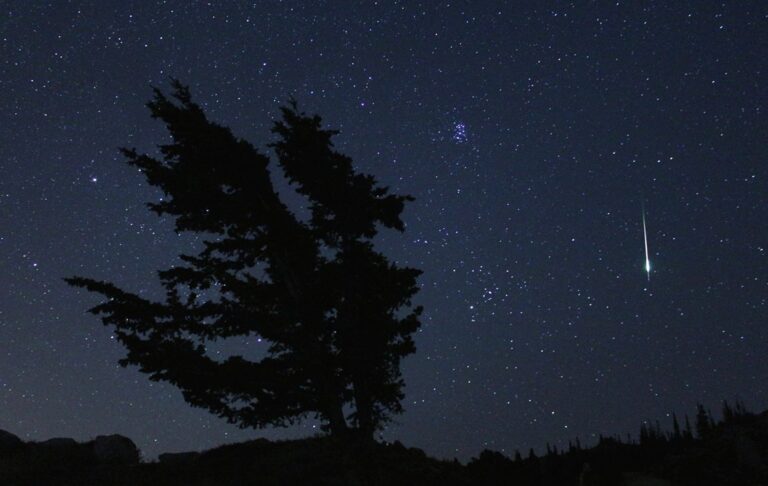
A meteor lights up the sky over Utah. – “Falling from Space,” NASA
Meteor explodes over Boston; sound echoes far and wide.
Wow, wow, wow. What was that?
That boom people in Boston heard around 2 p.m. on May 30 was a meteor exploding off the Massachusetts coast. The sound was so loud that people reported hearing it for miles.
The National Aeronautics and Space Administration (NASA) said the meteor, which was about 5 feet in diameter (the size of a medium-sized residential satellite dish), though the first reports had the meteor 3 feet across.
The meteor had a mass of 5.6 metric tons and entered Earth’s atmosphere traveling at about 75,000 mph. That’s about 100 times the speed of sound (761 mph) and about 122 times faster than a Boeing 747 (about 614 mph).
NASA said the meteor traveled from northwest to southeast through the atmosphere for 26 miles before breaking up 40 miles high over northeast Massachusetts and southeast New Hampshire, producing meteorites—meteor fragments—that fell into Cape Cod Bay.
CBS News said viewers blitzed Boston-based WBZ-TV’s newsroom with phone calls and said they heard the boom from as far away as Ipswich, Massachusetts, and Johnston, Rhode Island. American Meteor Society program monitor Robert Lunsford told several news outlets his organization received dozens of reports of meteor sightings, from Delaware to Montreal to Michigan.
Some callers to WBZ’s newsroom said they also felt their homes shake and their windows rattle, though a 1 Degree Outside meteorologist told Boston radio station WBUR that the U.S. Geological Survey didn’t report an earthquake.
WBZ said preliminary American Meteor Society reports had people in several states saying they’d seen the “bolide,” the bright flash that happens when a fireball meteor explodes in the atmosphere.
Scientists used more than 80 eyewitness reports from the public with images from NASA’s GOES-19 satellite to track the meteor’s atmospheric path and its pieces’ splashdown. The landing was not part of a meteor shower.
“This fall into water is technically called a ‘fishy squisher’ in uber-serious scientific terms,” NASA said in a cheeky online post.
In a June 3 update, NASA’s meteorite falls web page said four radars had tracked the falling meteorite KBOX (Boston), TBOS (Boston Logan Airport), KOKX (Long Island, New York), and KENX (Albany, New York). The agency also said experimental density measurements suggest the meteorite is made of iron, although overall radar reflectivity hadn’t yet confirmed this.
“This was a fairly fast-moving, steeply inclined meteoroid that broke up high in the atmosphere. It is evidently very mechanically strong, however, and produced very few small pieces,” NASA wrote June 3.
People will probably remember the sound for quite a while. Medfield, Massachusetts, resident Rich Sauro told The New York Times the sound jolted him from sleep.
“I thought a car hit my house,” he told the newspaper.
Meanwhile, a Norfolk, Virginia, reader identified as Alexander told Boston.com, “I heard a boom so loud, it was audible through my noise-canceling headphones, and I felt it in my chest.”
NASA scientists said the energy release after the meteor exploded was about the same as 300 tons, or about 600,000 pounds, of TNT exploding. For a back-of-the-envelope comparison, it took 600 pounds of explosives to raze most of Las Vegas’ Dunes hotel-casino in 1993, and about 4,000 pounds of explosives to raze Seattle’s Kingdome in 2000.
Although most meteors are tiny, pebble or sand-grain size, and burn up on entering Earth’s atmosphere, larger pieces sometimes get through, creating pressure waves as they hurtle downward. On his blog on Medium, Avi Loeb, the Frank B. Baird Jr. Professor of Science at Harvard University, said the meteor’s friction with air created a supersonic blast wave that produced the boom.
CBS News reported that weather radar detected meteorite debris over Cape Cod Bay at 64,000 feet, 49,000 feet, and 4,000 feet and that the likely debris field is about 10 miles northeast of Sandwich Harbor, 17 miles southeast of Plymouth, and 15 miles southwest of Provincetown.
Given that magnets attract meteorites, and this one was likely iron, based on NASA’s findings, researchers could probably pull fragments from the ocean floor.
***
Have a project ready to enter its professional orbit? We can write, edit, proofread or format it. Schedule a meeting with us, or check out our services to see what can do for you.
SOURCES
- American Meteor Society, “Fireball FAQs (with Bolide Definition).” Cited June 3, 2026.
- The Associated Press. “Meteor Over Massachusetts Causes Explosion Reports, Sightings from Delaware to Montreal.” Published May 30, 2026.
- Cooperative Institute for Research in the Atmosphere at Colorado State University. X post. May 30, 2026.
- DaSilva, M. “Exploding Meteor Causes Loud Boom Near Boston Area, Across New England.” WTNH-TV. Published May 31, 2026.
- Flower, J. and McNeil, C. “Experts Explain How Rare Meteor Created New England Sonic Boom.” WPRI.com. Published June 1, 2026.
- Flying. “How Fast Do Commercial Planes Fly?” Published February 28, 2025.
- The Guardian. “Meteor Over Massachusetts Prompts Reports of Booms Across US and Canada.” Published June 1, 2026.
- Howell, E. “Massive Boom Over Northeastern US Was A Meteor Explosion As Powerful As 300 Tons Of TNT, NASA Confirms.” Space. Published June 2, 2026.
- Loeb, A. “Avi Loeb Comments on the Meteor Explosion Over the Boston Area on May 30, 2026.” Medium. Published May 30, 2026.
- Mokam, B. “Was That an Alien Invasion? No, Just a Falling Rock, NASA Says.” The New York Times. Published May 30, 2026.
- National Aeronautics and Space Administration, X post. May 30, 2026.
- National Aeronautics and Space Administration, “Astromaterials Research & Exploration Science,” Meteorite Falls. Updated June 3, 2026.
- National Aeronautics and Space Administration, “Speed of Sound.” Cited June 3, 2026.
- Neon Museum Las Vegas. “The Dunes’ Dramatic Demolition.” Published September 3, 2025.
- Patkin, A. “A ‘Fishy Squisher’: NASA Confirms Meteorite Landed in Cape Cod Bay.” Boston.com. Published June 1, 2026.
- Riley, N. “Meteorite Heard In Massachusetts Landed “Right in the Middle of Cape Cod Bay,” NASA Says.” CBS News. Published June 1, 2026.
- Rourke, E. and Wycoff, J. “Meteor Explodes off Coast of Massachusetts, Causing Loud Boom.” CBS News. Published June 1, 2026.
- Santos, M. “Remembering the Kingdome’s Fall, 25 Years On.” Axios Seattle. Published May 25, 2025.
- Scalese, R. “Loud Boom Heard In Boston Likely Exploding Meteor Above Ocean.” WBUR. Published May 30, 2026.
- Zullo, D. “‘A Surreal Experience’: Readers React to Loud Boom in Mass. Caused by Meteor.” Boston.com. Published May 31, 2026.