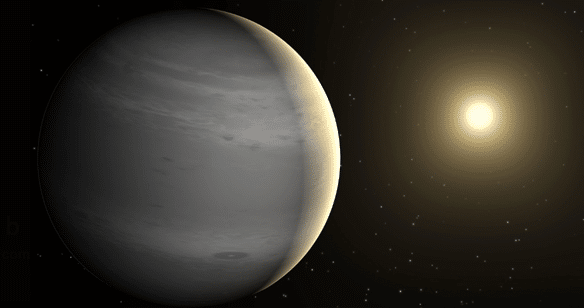
Artist concept of TOI-199 b – NASA
Using the James Webb Space Telescope, astronomers find planet with atmospheric temperatures similar to Earth’s.
There’s no place like home, there’s no place like home. Wait, maybe atmospherically, there is.
A new study, published May 20 in the Astronomical Journal, describes a Saturn-sized planet with a methane-rich atmosphere like Earth’s that was revealed by the James Webb Space Telescope. Penn State University astronomers led the study, joined by NASA’s Jet Propulsion Laboratory at the California Institute of Technology.
The planet, dubbed TOI-199 b, sits about 330 light-years from Earth. It’s one of a sparse few giant planets with temperate climates and the first so far with an atmospheric analysis. TOI-199 b’s atmosphere is different from the gaseous atmospheres on Jupiter and Saturn, which are extremely cold (hundreds of degrees below 0°F), given the planets’ distance from the sun.
TOI-199 b is also different from “hot Jupiters,” giant planets beyond the solar system that, because they closely orbit stars, have scorchingly hot atmospheres (thousands of degrees Fahrenheit, hot enough to evaporate iron). TheBrighterSide.news reported research on planets like TOI-199 b has been relatively scarce, partly because they have longer transits—the time when one object crosses in front of another in space — and orbits than hot Jupiters.
Hot Jupiters’ transits can be as quick as 1 to 4 hours, and their orbits can be as short as 10 days. TOI-199 b’s orbit is 105 days, and its transit was about 7 hours, Penn State researchers said. Hot Jupiters, Yale University researchers have said, are usually 1/10th the distance from their stars as Earth is from the sun. The researchers said details about TOI-199 b’s atmospheric composition will help them learn about how planets form and evolve, better understand Earth’s own atmospheric workings, and understand conditions that may accommodate human life.
TOI-199 b’s temperature is about 175°F, but Earth has come close, and given recent research, topped it. On July 10, 1913, California’s Furnace Creek reached 134.1°F; summertime temperatures there frequently top 113°F. In 2021, high-resolution satellite data showed temperatures hit 177.4°F in the Sonoran Desert on the Mexican–U.S. border and Iran’s Lut Desert. Also, as the Centers for Disease Control and Prevention reported, cars in direct sunlight can nearly meet TOI-199 b’s temperatures. On an 80°F day car insides can reach 118°F after 40 minutes and 123°F after an hour. Amateur scientists have experimented with baking cookies and other meals on dashboards. But we digress.
As TOI-199 b passed between the star it orbits and the Webb telescope, astronomers used the telescope’s instruments to break the star’s light into wavelengths. Atmospheric gases absorb some wavelengths. After having the telescope capture data during 20 hours observing TOI-199 b, researchers compared in-transit spectra with baseline spectra. Variations in the spectrum signal which molecules are in the planet’s atmosphere: Methane, and possibly carbon dioxide and ammonia, the researchers determined.
“The success of this first study of a temperate giant planet’s atmosphere also gives us confidence to dedicate more resources and observation time to study other similar planets,” Renyu Hu, an associate astronomy and astrophysics professor at Penn State’s Eberly College of Science and the research team’s leader, said on the university’s website. “We can then see if this planet is unique or if there are general shared characteristics for this type of planet.”
As TheBrighterSide.news reported, scientists expect moderate-temperature giant planets, which will have methane as their main carbon-bearing molecules and water as vapor, will let astronomers observe oxygen, nitrogen, and carbon under conditions that fall between the cold of Jupiter and Titan (Saturn’s largest moon) on one end, and the hottest gas giants on the other.
***
Have a project that needs to find its space? Nova Arc Content Co. can help. We’ll write, edit, proofread, or format it so it’s ready for its audience. Schedule a meeting with us or check out our services.
SOURCES
- Berry, D. “Hot Jupiters.” National Space and Aeronautics Administration. Published February 29, 2008.
- Cohen, L. “How Hot Does a Car Get in the Sun? Here’s Why Heat Can Be So Deadly in a Parked Car.” CBS News. Published July 24, 2023.
- Cowing, K. “Atmosphere of Saturn-Sized Planet With Earth-Like Temperature Contains Methane.” Astrobiology. Published May 21, 2026.
- de Lazaro, E. “Webb Detects Methane in Atmosphere of Exo-Saturn TOI-199b.” Sci News. Published May 25, 2026.
- Fortney, J., Dawson, R. amd Komacek, T. “Hot Jupiters: Origins, Structure, Atmospheres.” American Geophysical Union. Published February 8, 2021.
- Rails, E. “Webb Detects Methane on a Giant Planet with Surprisingly Mild Temperatures.” Earth.com. Published May 22, 2026.
- Science Direct. “Hot Jupiters.” Cited May 26, 2026.
- Shavit, J. “JWST Finds Methane in the Atmosphere of a Rare Temperate Saturn-Sized Planet.” TheBrighterSide.news.com. Published May 22, 2026.
- Sholtis, S. “Atmosphere of Saturn-Sized Planet with Earth-Like Temperature Contains Methane.” Penn State University. Published May 20, 2026.
- Stone, R. “Move over, Death Valley: These Are the Two Hottest Spots on Earth.” Science. Published May 19, 2021.
- Tkatch, A. “For the First Time, Astronomers Conduct a Detailed Study of a Temperate Gas Giant’s Atmosphere.” InKorr. Published May 23, 2026.
- Totten, K. “Cookies, Sure, But Can You Cook Chicken On Your Dashboard?” KNPR-FM. Published August 3, 2018.
- Wang, J. “Hot Jupiters and Stellar Multiplicity.” Yale University. Cited May 26, 2026.