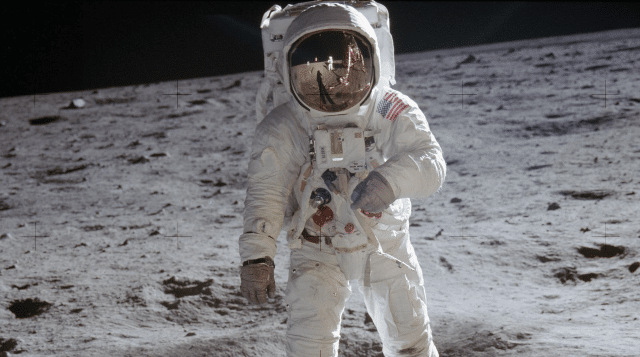
Astronaut Edwin E. Aldrin Jr. walks on the surface of the moon. – NASA
NASA eyes return trip to the moon as it marks 57 years since Apollo 11 landing.
Fifty-seven years ago, on July 20, 1969, four days after lifting off from the Kennedy Space Center in Merritt Island, Florida, Apollo 11 and Neil Armstrong landed on the moon. A reported 650 million people tuned in on television to watch the landing, the first time anyone had walked on the moon.
As he trod the surface, Armstrong famously said, “That’s one small step for man, one giant leap for mankind.”
Apollo 11, crewed by Armstrong, Edwin “Buzz” Aldrin, and Michael Collins, would spend 21 hours, 36 minutes on the moon’s surface. The landing and mission marked a U.S. achievement in the furious 1960s space race touched off when the Soviet Union launched its Sputnik satellite Oct. 4, 1957. And it fulfilled President John F. Kennedy’s 1961 goal to land crewed spacecraft on the moon and return to Earth.
“I believe that this nation should commit itself to achieving the goal, before this decade is out, of landing a man on the moon and returning him safely to the Earth,” Kennedy had told Congress on May 25, 1961, in an address on urgent national needs. “No single space project in this period will be more impressive to mankind, or more important for the long-range exploration of space.”
NASA is again eyeing the moon, planning a return trip and imagining a base. Those projects will likely take feats of engineering, just like the ones those 1960s engineers achieved after hearing Kennedy’s call. The American Society of Mechanical Engineers named Apollo 11’s lunar module and the Saturn V rocket as National Historic Mechanical Engineering Landmarks.
Bethpage, New York-based Grumman Aircraft Engineering Corp. took seven years to design and build the Apollo 11 spacecraft, dubbed LM-5 and nicknamed Eagle. Grumman received the contract on Nov. 7, 1962, and began work in January 1963. (Northrop Corp. acquired Grumman Corp. for $2.1 billion in 1994 to form aerospace giant Northrop Grumman.)
NASA had imagined the Apollo command and service (lunar) modules landing and taking off together from the moon’s surface, but that wouldn’t work. As American Essence magazine reported, getting such a combination into space would require a rocket bigger than anything ever developed.
Langley Research Center engineer John Houbolt solved this problem, proposing that the command module carry a smaller module to land on the moon separately. The lunar module would later rejoin the command module, which would orbit the moon in the interim. In all, American Essence estimated, Apollo 11 collectively weighed 30,200 pounds. (You fly 15 tons, and what do you get? History.)
Designing the module raised questions, and challenges, nobody could answer yet. How big would the module have to be to accommodate the fuel tanks to lift it? How big would the fuel tanks have to be? Would the cockpit allow the astronauts to stand or sit? How big could the windows be, knowing that thick glass was heavy and too much glass could cause a thermal imbalance and tax the internal climate system? How would the astronauts get from the lunar module to the command module? And, besides that, what would the moon be like? There was no data to build on.
During interviews with the American Society of Mechanical Engineers in 2019, the Apollo 11 landing’s 50th anniversary, engineers recalled the thrill of pursuing these answers.
“We were developing technology that had never been used before,” engineer Anthony Cacioppo said. “Talk about an adventure. That’s part of the legacy that I look back on.”
Mike Lisa, an instrumentation engineer, performed thermal vacuum, shock, and vibration tests to ensure the lunar module’s components could handle space travel.
“We knew what we had to achieve,” he told the society. “And once we achieved that, we had to go beyond it.”
Science and engineering got Apollo to the moon; science and engineering continued after it landed.
As the American Museum of Natural History recounted, Aldrin and Armstrong then set out to plant instruments. Seismometers to measure moonquakes or meteoroid effects. A laser ranging retroreflector to time how quickly a laser beam traveled from Earth to the moon’s surface and back and precisely measure the Earth-moon distance.
The astronauts also collected soil and rock samples that revealed evidence of a volcanically created “magma ocean” and evidence of repeated collisions with meteors. NASA said the Apollo program spurred innovations we’d recognize now, including nutrients-preserving freeze-dried foods; water purification technology; retroreflectors for detecting hazardous gases, and ways to chemically remove toxic waste from recycled fluids (which figures now in kidney dialysis).
Aldrin, who is now 96, is the Apollo 11 crew’s last living member (Armstrong died in 2012; Collins died in 2021). In 2025, he marked the lunar landing’s anniversary by taking a call from Pope Leo XIV and posting on X about the value of collaboration.
“An achievement resulting from years of incalculable effort, commitment, and team work,” the post said. “We all did our part to see President Kennedy’s words become reality: ‘We choose to go to the Moon in this decade and do the other things, not because they are easy, but because they are hard.’”
Looking toward the moon anew, NASA this past April sent Artemis II on a 10-day flyby. The mission captured worldwide attention; Space.com reported that an agency record 149.4 million people used NASA web platforms in March and April to follow the mission, the first moon journey since Apollo 17’s 1972 landing and the farthest any humans had ever flown.
NASA is planning an Artemis lunar landing for 2028 and said in a July 15 release that it’s working with Blue Origin and SpaceX to develop human landing systems to ferry astronauts from the moon’s orbit to the moon’s surface and back.
On July 1, NASA announced progress on plans to send astronauts back to the moon and build a permanent base near the moon’s southern pole.
“This is drawing on the playbook that worked very well for NASA during the 1960s. We didn’t just jump right to Apollo 11,” NASA Administrator Jared Isaacman told ABC News. “We want to get back into a rhythm of this. … Let’s do a lot of littles, and let’s learn from every one of them.”
Apollo’s engineers ran vibration and thermal tests to prepare a module that had never flown. Today’s NASA engineers are running different preparatory tests, sending autonomous vehicles, drones, and robots to answer questions about the pole’s extreme temperatures, abrasive dust, and prolonged darkness before any astronaut steps there.
In a statement, NASA said it’s considering sending PROMISE (Polar Rover for Observation, Mapping, and In-Situ Exploration), a version of the Mars Perseverance and Curiosity rovers, to the moon. NASA said it will also take proposals for lunar landers and an optical imager and will seek a lunar communication relay to boost moon base-to-Earth communications.
As part of the moon base program, NASA awarded Astrobotic $297.9 million (to make two supplies-and-resources deliveries) and Firefly Aerospace $144.2 million and Intuitive Machines $148.3 million (one supplies-and-resources delivery each).
Equipment from the planned deliveries will include a stereo camera for lunar plume surface studies, a four-camera array to show in 3D how a lander might unsettle lunar dust; a laser retroreflector array to help landing spacecraft or moon orbiters steer to the surface; and a linear energy transfer spectrometer to better understand lunar surface radiation.
The United Nations in December 2021 honored Apollo 11’s achievement, declaring July 20 as International Moon Day, and setting it as an annual celebration. Several U.S. locales will celebrate with festivals and planetarium displays. Space.com has an observer’s guide to help people spot the moon sites where Apollo missions landed.
Notably, the USS Hornet Sea Air and Space Museum in Alameda, California, will mark the 2026 anniversary by displaying a rebuilt version of Apollo 11 and a special Smithsonian Institution-commissioned presentation about the spacecraft’s command module. A 3D laser scan of the module’s insides will offer a fresh, and previously unmatched, view of the long-sealed vessel, the Alameda Post reported.
The Hornet collected Armstrong, Aldrin, and Collins after Apollo 11 splashed down in the Pacific Ocean after returning to Earth. The craft hit water 812 nautical miles southwest of Hawaii, the Post reported, and a helicopter took the astronauts, clad in biological isolation garments, to the ship. (The suits were a precaution; NASA didn’t know whether exposure to the moon’s surface had exposed the Apollo 11 crew to hazardous organisms.)
U.S. Navy divers used a sea anchor to keep the Hornet steady and tethered a life raft for the astronauts. (Sea anchors work like underwater parachutes; when they’re submerged, they trap water and drag in the water, resisting wind and waves that would otherwise push the ship sideways.)
Apollo 11’s crew spent 88 hours in a mobile quarantine unit aboard the Hornet then flew to the Lunar Receiving Laboratory at what is now the Johnson Space Center in Houston to complete the rest of their 21-day isolation period; it ended Aug.10, 1969. Afterward, Aldrin, Armstrong, and Collins spent a day with their families, reported back to their offices for an Aug. 12 postflight press conference and then embarked on a heroes’ tour. Parades celebrated them in New York and Chicago; a state dinner followed in Los Angeles, hosted by President Richard Nixon, 44 state governors, 83 foreign ambassadors, and most active astronauts, NASA reported.
The astronauts returned to Houston on Aug. 16, for a welcome home parade; the day ended with a barbecue party and tribute to NASA in the Astrodome, with Frank Sinatra as master of ceremonies.
During the press conference, Armstrong reflected on the crew’s shared experience.
“It was our pleasure to participate in one great adventure. It’s an adventure that took place, not just in the month of July, but rather one that took place in the last decade,” he said. “It’s our privilege today to share with you some of the details of that final month of July that was certainly the highlight, for the three of us, of that decade.”
Armstrong and Aldrin acknowledged enjoying themselves as busy as they were on the moon’s surface. “We had the problem of the 5-year-old boy in a candy store. There are just too many interesting things to do.”
Collins later said, “I think it a technical triumph for this country to have said what it was going to do a number of years ago, and then by golly, do it. That’s short term. I think long term, we find for the first time that man has the flexibility or the option of either walking this planet or some other planet, be it the moon or Mars, or I don’t know where. And I’m poorly equipped to evaluate where that may lead us to.”
***
Have a writing project ready for takeoff? Nova Arc Content Co. can write, edit, proofread, or format it. Schedule a meeting with us or check out our services to see what we can do for you.
SOURCES
- Alameda Post. “USS Hornet Celebrates Apollo 11 Splashdown Anniversary.” Published July 14, 2026.
- Aldrin, B. “X post.” Published July 20, 2025.
- Alvarado, B. and Glasser, M. “NASA Says It’s ‘Making a Lot of Progress. on Moon Base Plans, May Send a Spare Mars Rover to the Lunar Surface.” ABC News. Published July 1, 2026.
- American Museum of Natural History. “The Scientific Legacy of the Apollo 11 Mission.” Published July 19, 2019.
- American Society of Mechanical Engineers. “The Lunar Module: A National Historic Mechanical Engineering Landmark.” Published April 10, 2002.
- Arrington. B. “Storm Drogues and Sea Anchors, Explained.” Passagemaker. Published September 14, 2023.
- The Associated Press. “Pope Leo XIV Marks 56th Anniversary Of Moon Landing With Observatory Visit, Call To Buzz Aldrin.” Published July 21, 2025.
- Atkinson, S. “Apollo Landing Sites: An Observer’s Guide on How to Spot Them on the Moon.” Published June 30, 2021.
- Beckinger, C. “How NASA’s Artemis III Lander Test Will Pave Way for Moon Landings.” National Aeronautics and Space Administration. Published July 15, 2026.
- De Rújula, A. “Apollo 11 and Fundamental Science.” Inference. Published May 2020.
- Education Resources Information Center. “The First Lunar Landing.” Cited July 15, 2026.
- Eicher, D. “What the Apollo Moon Rocks Told Us.” Astronomy. Published May 18, 2023.
- Howell, E. “149 Million Views! Artemis II Moon Mission Breaks NASA’s Streaming Record.” Space.com. Published July 12, 2026.
- Howell, E. “Apollo 17: The Final Moon Mission of the Apollo Era.” Space.com. Published December 6, 2022.
- Huntsville Business Journal, “Ready for Launch: Huntsville Hosting Inaugural Rocket City Space Fest.” Published July 13, 2026.
- Kirchman, B. “Grumman Engineering Had to Get 30,200 Pounds of Apollo Spacecraft to Moon and Back.” American Essence. Published November 22, 2022.
- KPIX-TV via YouTube. “A look at the USS Hornet’s Apollo 11 recovery mission exhibit.” Published April 10, 2026.
- Lacey, D. “Rocket City Space Fest’s Own Moonshot.” Axios Huntsville. Published July 10, 2026.
- Lewis, C. “What Was Sputnik and Why Was It Important? The Space Age Begins.” National Air and Space Museum. Published October 3, 2017.
- Loff, S. “Apollo 11 Mission Overview.” National Aeronautics and Space Administration. Published April 17, 2015.
- Low, L. E. “NASA Awards More Moon Base Science, Previews New Opportunities.” National Aeronautics and Space Administration. Published June 30, 2026.
- Lubov, D. C.“Apollo 11 Anniversary: Pope Leo XIV Speaks with Astronaut Buzz Aldrin.” Vatican News. Published July 21, 2025.
- Lunar and Planetary Institute. “Apollo 11 Lunar Samples.” Cited July 15, 2026.
- Maielli, M. “How Does Artemis II’s Re-Entry Differ from the Apollo Missions?” WSDU-TV, New Orleans. Published April 10, 2026.
- National Aeronautics and Space Administration. “The Harsh Environment of the Lunar South Pole.” Cited July 14, 2026.
- National Aeronautics and Space Administration. “55 Years Ago: Apollo 11 Astronauts End Quarantine, Feted from Coast to Coast.” Published August 20, 2024.
- National Aeronautics and Space Administration. “The Decision to Go to the Moon: President John F. Kennedy’s May 25, 1961, Speech Before a Joint Session of Congress.” Published September 22, 1998.
- National Aeronautics and Space Administration. “Apollo 11 Moon Landing: 50th Anniversary.” Cited July 16, 2026.
- National Air and Space Museum. “What Was the Space Race?” Published August 23, 2023.
- Norman, L. “After 56th Anniversary of the Moon Landing, When Is The Next Full Moon? What To Know.” Published July 22, 2025.
- O’Heir, J. “Engineers Remember the Making of the Lunar Module.” American Society of Mechanical Engineers. Published July 1, 2019.
- Reichhardt, T. “Twenty People Who Made Apollo Happen.” Smithsonian Magazine. Published May 2019.
- Snibbe, K. “On Apollo 11 Lunar Landing Anniversary, We Look At Future Missions To The Moon.” Orange County Register via San Jose Mercury News. Published July 21, 2025.
- Tillman, N. T. “Space Launch System: NASA’s Megarocket for Artemis Moon Missions.” Space.com. Published March 16, 2022.
- United Nations. “International Moon Day.” Cited July 13, 2026.
- WNEM-TV. “Delta College Planetarium Marks Anniversary Of First Moon Landing.” Published July 13, 2026.