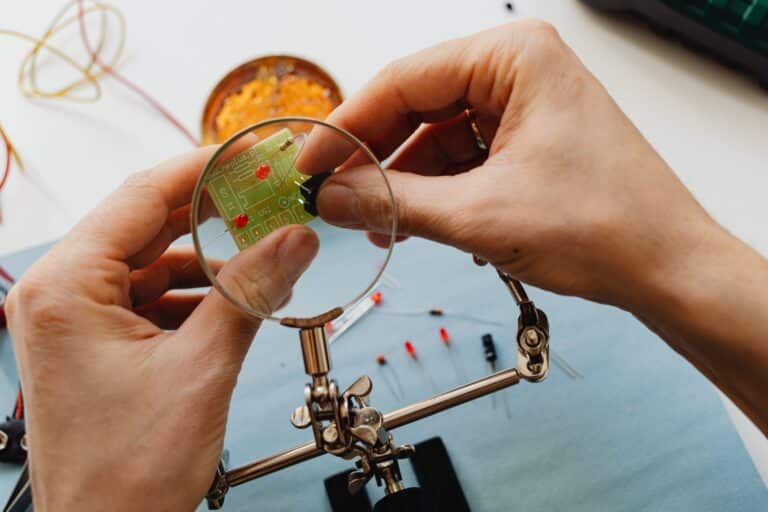
Hands working on a circuit board. – Pexels
Biodegradable circuit boards curb waste and offer a path toward greener, more sustainable electronics.
Maybe Willy Wonka was onto something. Roald Dahl’s well-known chocolatier was famous for his imaginative creations, which had fanciful names (Everlasting Gobstopper, anyone?) and legions of fans. His confectionaries were inventive, though it’s doubtful even Wonka couldn’t have imagined chocolate bars as electronic components. But a group of Scottish scientists has.
Eco-minded researchers from the University of Glasgow’s James Watt School of Engineering have proposed using biodegradable elements to replace the plastics and chemicals in printed circuit boards to reduce or eliminate electronic waste. One imagined circuit board medium is chocolate. (More on that shortly.) Other substances imagined for circuit boards include paper, leaves, mushroom skins, hemp, jute, silk, and bioplastics.
Traditionally manufactured circuit boards make up 4% to 7% of e-waste, with approximately 90% intrinsic value in their precious metal content, Indian researchers have found. And once these boards reach landfills, they can stay for years. Rakesh Nair, a postdoctoral researcher at Dresden University of Technology studying leaves as a circuit board medium (“Leaftronics”), told Anthropocene magazine that materials in circuit boards can last for decades but go into electronic products designed for obsolescence within years.
The Brussels-based International Waste Electrical and Electronic Equipment Forum estimated worldwide electronic waste hit 54.7 million tons in 2021, up 2% from 53.6 million tons in 2019. That number could top 74 million tons by 2030 without intervention, the forum forecast.
John W. Mitchell, a board member for the U.S. Partnership for Assured Electronics, a nonprofit industry group, hailed sustainable circuit board projects. “Innovations like these could help reduce the environmental impact of modern electronics,” he told Sustainability magazine.
The Glasgow researchers said in a Feb. 2, 2026, paper that they’d found a way to print electronic circuits on eco-friendly materials including paper and bioplastics. When the boards’ zinc circuits have served their purpose, the boards’ other materials can dissolve in vinegar or compost in soil.
Instead of using copper for the printed circuit board traces that connect electronic components, the Glasgow team used zinc. The board’s traces (or tracks), conductive metal strips that link electronic components, are 5 microns wide.
Conventional printed circuit board fabrication may involve etching copper from a full sheet, which wastes a lot of copper. So, the Glasgow researchers deposited conductive material only where they needed tracks, using less metal and forgoing the harsh chemicals for etching.
To build these boards, the Glasgow engineers electroplated conductive bulk zinc onto a temporary carrier and grafted it onto a biodegradable base. In their paper, the Glasgow researchers said that tests in light-emitting-diode counters, temperature sensors, and tactile sensors showed the circuits performing comparably with traditional copper-and-plastic boards and doing so for a year when kept in ambient conditions.
“Almost any substrate material can be used in the process, ranging from paper and bioplastics for more realistic applications, to chocolate for tasty but probably not very practical demonstrations,” James Watt School of Engineering’s professor Jeff Kettle said in a university statement.
The Glasgow team told EE News Europe that they expected the boards could last up to two years, making them best for short-lifetime electronics, such as smart labels, electronic pregnancy tests, and disposable sensors.
Like the Glasgow group, Swiss scientists are examining sustainable board alternatives, but as part of Hypelignum, a European Union project aiming to conceptualize and manufacture net-zero carbon electronics. (Hypelignum is a portmanteau, combining hybrid printed electronics (hype) lignum, or forest-based materials.
A study published in March 2025 in the journal Nature shows that Swiss researchers led by Thomas Geiger of Empa’s Cellulose and Wood Materials Laboratory have developed a wood-based, biodegradable printed circuit board substrate that works comparably to conventional epoxy resin and has functioned in computer mice.
The boards’ base material is lignocellulose, wood biomass composed of cellulose, hemicellulose, and lignin, and rendered by the ton in industrial farming. Researchers used water to break down cellulose fibers, then squeezed out the water under high pressure. This caused the fibers to move together and dry into a solid mass. When the plant-based circuit boards reach the end of serviceability, users can compost the base material and remove the electronic and metallic parts for recycling.
Here in the United States, researchers from the University of Maryland, University of Notre Dame, and Georgia Tech created DissolvPCB, a dissolvable circuit board. Like the Glasgow team’s board, DissolvPCB is targeted small, for batch manufacturing, education, and prototypes.
ZME Science reported that instead of using copper, the researchers injected a gallium-indium alloy liquid metal into printed channels to allow electrical flow. Instead of printing the boards with epoxy and fiberglass, the team used polyvinyl alcohol, a plastic that dissolves when dunked in water.
The researchers used the boards, made partly with 3D printing, in three gadgets—a finger gripper that bends when powered, an electronic fidget cube, and a Bluetooth speaker with a double-layer dissolvable board. Recycling the boards took about 36 hours (less with heat and stirring) and yielded liquid metal beads and intact electronic components that were fine to use after drying. The researchers ground the polyvinyl plastic and reextruded it for new 3D printing.
These boards’ clean breakdown can save waste and disposal costs. Tech Xplore, a tech-and-engineering news site, reported that traditional copper-trace printed circuit boards have petroleum-derived, fiber-reinforced epoxy resin traces, which can require pyrolysis furnaces (which use heat to break down materials with oxygen absent) for disposal followed by exhaust air purification.
The Watt School’s Dr Jon Harwell said these projects mark an important step for ecologically minded electronics. “Discarded devices already generate tens of millions of tons of waste annually,” he told Electronic Specifier, an electronics engineering and manufacturing information website. “So our research could have far-reaching impacts for consumer electronics, internet-of-things devices and disposable sensors in the future.”
***
At Nova Arc, we live at the intersection of cutting-edge innovation and mindful, sustainable use of resources. We’re ready to partner on content that helps make our world a better place—from innovative technology to future-forward sustainability ideas, we’re here for it all. Schedule a meeting with us or check out our writing, editing, and design services to see what we can do for you.
SOURCES
- Andrei, M. “This 3D Printed Circuit Board That Dissolves In Water Could Finally Solve Our E-Waste Problem.” Published September 1, 2025.
- Anthropocene magazine. “Circuit Boards Made From Leaves Could Green Up Electronics’ Act.” Published Dec. 12, 2024.
- CE Waste. “WEEE Forum.” Cited June 30, 2026.
- Cuthbertson, A. “Chocolate Circuit Boards Offer ‘Tasty’ Solution To E-Waste.” Independent UK. Published January 20, 2026.
- Darley, J. “Inside TU Dresden’s Compostable Electronics Made From Leaves.” Sustainability magazine. Published January 7, 2005.
- Dudnyk, Y., Kulha, P., Procházka, V., Nyström, G., and Geiger, T. “Printed Circuit Board Substrates Derived from Lignocellulose Nanofibrils for Sustainable Electronics Applications.” Nature. Published: March 8, 2025.
- Ettlin, A. “Green Electronics Thanks to Biodegradable Circuit Boards.” Tech Xplore. Published October 7, 2025.
- Empa. “Cellulose and Wood Materials Laboratory (overview).” Cited June 29, 2026.
- Harwell, J.R., Zhang, T, Rollo, A, Wagih, M., and Kettle, J. “Additively Manufacturing Printed Circuit Boards With Low Waste Footprint By Transferring Electroplated Zinc Tracks.” Communications Materials. Published December 13, 2025.
- Hypelignum. “What Is Hypelignum?” Cited June 29, 2026.
- Innovation News Network. “Combatting Electronic Waste With Biodegradable Circuit Boards.” Published October 10, 2022.
- McEvoy, E. “Hemp to Be Tested as a Biodegradable Material in Printed Circuit Board Manufacturing.” Cannabis Science and Technology. Published January 31, 2024.
- Miles, S. “Biodegradable, Zinc-Based Circuit Boards Reduce E-Waste.” Electronic Specifier. Published January 27, 2026.
- Mir, S. and Dhawan, N. “A Comprehensive Review on the Recycling of Discarded Printed Circuit Boards for Resource Recovery.” ScienceDirect. Published March 2022.
- Nair, R, Wolansky, J., Uhlig, K., Solgi, A,, Teuerle, L., Zhang, T., Schröder, J., Antrack, T., Benduhn, J., Kleeman, H., and Leo, K. “Leaftronics: Natural Lignocellulose Scaffolds For Sustainable Electronics.” Science Advances. Published November 8, 2024.
- Neascu, A. “Biodegradable PCB Targets Short-Lifetime Electronics” EE News Europe. Published February 5, 2026.
- Ojo, A. “An Overview of Lignocellulose and Its Biotechnological Importance in High-Value Product Production.” MDPI. Published November 20, 2023.
- Science Direct. “Pyrolysis (definition).” Cited June 29, 2026.
- Rush PCB. “Importance of Correct Sizing of PCB Traces in PCB Design.” Published October 3, 2021.
- Snowden, S. “Glasgow Researchers Develop Compostable Circuit Boards.” Resource Recycling. Published February 3, 2026.
- University of Glasgow. “Compostable Circuits Could Slash Environmental Impact Of Electronics.” Published January 20, 2026.
- University of Notre Dame College of Engineering. “Tackling E-Waste With Biodegradable Electronics.” Published November 25, 2025.
- Waseem, U. “Types of Printed Circuit Boards: A Comprehensive Guide.” Wevolver. Published April 18, 2024.