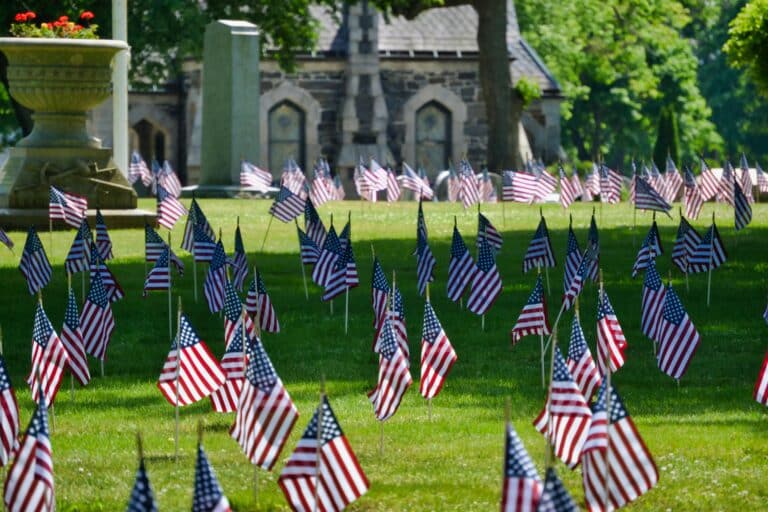
Rows of American flags displayed on a sunny lawn in Boston, USA, symbolizing patriotism, Mark Agard – Pexels
Reflecting on the origins of Memorial Day traditions inspired by gratitude for those who sacrificed it all.
To many U.S. citizens, Memorial Day is synonymous with camping trips, the biggest sales of the season, backyard barbecues, and the unofficial start of summer. However, the holiday’s origins and traditions are much more historically and culturally significant.
Memorial Day’s History
Before the Civil War ended in 1865, communities began to formally honor the dead by placing flowers on soldiers’ graves during springtime “decoration days.” When the war was over, 620,000 people—2% of America’s population—had lost their lives.
Believed by some to be the predecessor of northerners’ Memorial Day, southerners’ decoration days brought communities together at cemeteries to share a meal, sing songs, and clean and decorate graves. However, this tradition, which was similar to older traditions, such as Flowering Sunday in Wales, was not celebrated on the same day each year, but varied by community.
Many places claim to be the birthplace of Decoration Day. One of the first, according to The U.S. Department of Veteran Affairs, occurred in Columbus, Mississippi, in April 1866 when a group of women gathered to decorate Confederate graves with flowers. The women were disturbed to see that the graves of Union soldiers had been neglected, so they decorated their graves as well. Another early ceremony was held in May 1865 in Charleston, South Carolina at the Washington Race Course and Jockey Club, which the Confederate Army had tuned into a prison camp. There, newly freed Black people discovered and reburied 257 Union soldiers who had died from disease and exposure and had then been hastily buried in a mass grave. The new graves were decorated with flowers, and attendees marched in a parade around the racetrack.
It wasn’t until May 1868 that John A. Logan, a politician, U.S. Union general, and the national commander of the Grand Army of the Republic, issued orders to name May 30 (believed to be chosen because flowers would be in bloom everywhere across the country) of each year a remembrance “for the purpose of strewing with flowers or otherwise decorating the graves of comrades who died in defense of their country during the late rebellion, and whose bodies now lie in almost every city, village, and hamlet churchyard in the land.”
On the first recognized Decoration Day in Arlington Cemetery on May 30, 1868, a crowd of 5,000 gathered to visit thousands of fallen soldiers’ graves.
Modern Memorial Day Observances
Not until after World War I did the holiday become a day to honor and remember all those who had died in U.S. wars—a casualty count that now totals over 1 million. Memorial Day was later declared a national holiday by an act of Congress in 1971, when it was also placed on the last Monday in May.
The modern proclamation asks for citizens to observe the holiday by “praying, according to their individual religious faith for permanent peace.” In 2000, President Bill Clinton signed “The National Moment of Remembrance Act” to encourage citizens to participate in a moment of gratitude for those who died in service on Memorial Day at 3:00 p.m. (local time) by pausing for a moment of silence or listening to “Taps,” according to a historical White House webpage.
The purposes of the National Moment of Remembrance, with origins that go back to the devastation of the Civil War, is to join with people around the world in a symbolic act of unity, to remind each of us of the importance of remembering those who died in service to the U.S., to demonstrate gratitude, and to make known to younger generations the real meaning of Memorial Day.
In 1869, Paul Lawrence Dunbar, an early Black poet and the son of a former slave who served in the U.S. Colored Troops in the Civil War wrote “Ode for Memorial Day.” The last stanza of the poem describes “flowers of charity, peace, and devotion” growing from the ground where the dead are buried—a picture we can reflect on as we honor the fallen again this year.
Out of the blood of a conflict fraternal,
Out of the dust and the dimness of death,
Burst into blossoms of glory eternal
Flowers that sweeten the world with their breath.
Flowers of charity, peace, and devotion
Bloom in the hearts that are empty of strife;
Love that is boundless and broad as the ocean
Leaps into beauty and fullness of life.
So, with the singing of paeans and chorals,
And with the flag flashing high in the sun,
Place on the graves of our heroes the laurels
Which their unfaltering valor has won!
Sources
- National Cemetery Administration. “Memorial Day History.” Accessed 22 May 2026. https://cem.va.gov/history/Memorial-Day-History.asp
- Public Broadcasting Service (PBS). “Civil War Facts.” Accessed 22 May 2026. https://www.pbs.org/kenburns/the-civil-war/civil-war-facts
- Brown, P. “’Decoration Day’: The South Honors Its Dead.” Adapted from Weekend Edition Saturday. National Public Radio (NPR). 28 May 2011. https://www.npr.org/2011/05/28/136742729/decoration-day-the-southern-way-to-honor-the-dead
- U.S. Celebrating America’s Freedoms. “Celebrating America’s Freedoms: The Origins of Memorial Day.” Accessed 22 May 2026. https://www.va.gov/OPA/PUBLICATIONS/CELEBRATE/MEMDAY.PDF
- Ross, D. “One of the Earliest Memorial Day Ceremonies Was Held by Freed African Americans.” History. 24 May 2019. https://www.history.com/articles/memorial-day-civil-war-slavery-charleston
- National Park Service. “Memorial Day – Over 150 Years of Remembrance.” Accessed 22 May 2026. https://www.nps.gov/articles/memorial-day-history.htm
- Tucker, N. “From Decoration Day to Memorial Day.” Library of Congress Blogs. 23 May 2025. https://blogs.loc.gov/loc/2025/05/from-decoration-day-to-memorial-day/
- Weber, J. L. “The Military Background of the War in American Civil War.” Britannica. 17 May 2026. https://www.britannica.com/event/American-Civil-War/The-military-background-of-the-war
- Cornell Law School. “36 U.S. Code § 116 – Memorial Day.” Accessed 22 May 2026. https://www.law.cornell.edu/uscode/text/36/116
- The Clinton White House Archives. “National Moment of Remembrance.” 29 May 2000. https://clintonwhitehouse3.archives.gov/remembrance/factsheet.html