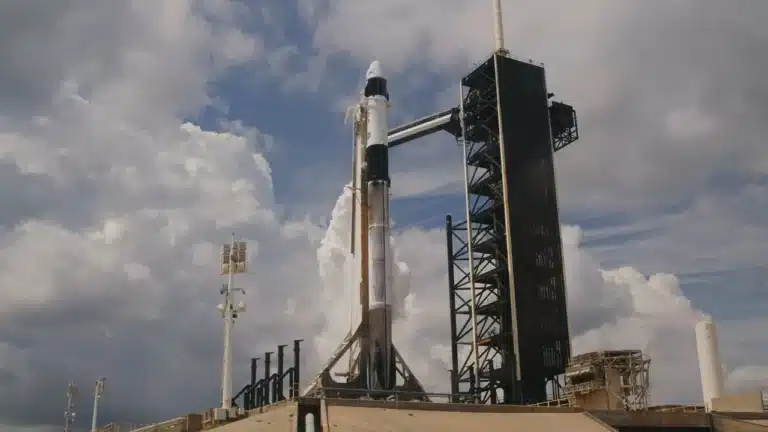
A SpaceX Falcon 9 rocket prepare for launch at Kennedy Space Center in Florida on Friday, Aug. 1, 2025. – NASA
SpaceX, which has revolutionized space travel, tops $1 trillion in valuation with initial public offering.
Don’t adjust your screen. The following numbers are mind-boggling, but real.
Elon Musk’s SpaceX had its initial public stock offering June 12, aiming to raise $75 billion (issuing 555,555,555 SpaceX shares priced at $135), an amount that would push the company’s valuation to $1.75 trillion. (A valuation assesses a company’s management, capital structure, future earnings, and asset market value.)
SpaceX smashed through those benchmarks. The offering raised $87 billion. The stock price, which opened at the aforementioned $135, hit $209 during trading June 12 before closing at $160.95, up 19.2%. The stock closed at $211.39 June 16, up 56.5% from the initial public offering (IPO) price. SpaceX’s $2.78 trillion valuation as of June 16 eclipsed Jeff Bezos’ Amazon, valued at $2.66 trillion. SpaceX’s IPO was the biggest since 2019, when Saudi Aramco, Saudi Arabia’s state-owned oil company, was valued at $1.7 trillion and raised more than $29 billion.
SpaceX’s IPO was such a big deal that the tech-stock-heavy Nasdaq 100 altered its methodology to allow SpaceX fast entry—just 15 trading days after the IPO. Michael Finke, an American College of Financial Services wealth management professor, told Yahoo Finance the move was risky. “By convincing the index to let you in right from the start, SpaceX gets an instant flow of investment dollars without having to grow organically because it has a good business model,” Finke said.
The S&P 500 and Dow Jones Industrial Average did not bend rules for SpaceX. Both indexes require companies to have made a profit in their most recent quarters and collectively over its last four quarters to be included. As Fortune noted, SpaceX lost $4.9 billion in 2025 and $4.3 billion more in 2026’s first three months.
The IPO made Musk—who also owns electric carmaker Tesla, satellite company Starlink, and artificial intelligence company xAI—the world’s first trillionaire. He had already been the world’s richest man, having risen from 35th place in 2020. Musk controls 85% of the vote at the new public SpaceX, which, Mashable notes, means his board of directors would be hard-pressed to oust him as CEO.
As Fortune reported, SpaceX, which Musk founded in 2002 with a share of the $180 million in proceeds from selling payment system PayPal, has forever changed space travel and space-based communications. SpaceX claimed more than 80% of global rocket launches in 2025 and has more than 10,000 Starlink satellites in orbit, which deliver space-based internet connections to militaries (including the Ukrainian army), businesses, and households.
As science and technology consulting company BryceTech reported, in 2024 SpaceX conducted a record 134 orbital launches, more than twice the launches by the next-closest launcher, the China Aerospace Science and Technology Corp.
Since 2020, NASA has used Crew Dragon, a SpaceX-designed craft, to take U.S. astronauts to the International Space Station. SpaceX has launched and landed its Falcon 9 rocket, a reusable, two-stage rocket, more than 600 times. The reusability matters; rockets historically had been fully disposable; big launch system segments were destroyed after every mission.
SpaceX said in a government filing that it flew 85% of its Falcon 9 missions with reused boosters. One Falcon 9 booster, B1067, made headlines in June 2026 by marking 35 launches and landings in five years. That nears NASA space shuttle Discovery’s 39 spaceflights over nearly four decades.
As The New Yorker enumerated, SpaceX complemented all these launches by developing reusable rocket parts and pushing out Boeing Co. to become the Pentagon’s chief launch supplier. Besides developing rockets, rocket parts, and satellites, in 2024 SpaceX reportedly agreed to a $1.8 billion National Reconnaissance Office contract to develop Starshield, a spy satellite network. And, in May 2026, the U.S. Space Force, a U.S. Air Force offshoot formally established in 2019, awarded SpaceX a $4.16 billion contract to build a satellite network to track airborne targets from orbit.
But in the beginning, as CNBC reported, SpaceX needed U.S. government aid to, um, get off the ground.
In 2004, the Defense Advanced Research Projects Agency, or DARPA, and the U.S. Air Force reached an $8 million deal with SpaceX to develop the Falcon I, a small launch vehicle, to send up-to-990-pound payloads into space for $5 million per launch or less. Even with this support, SpaceX’s first three Falcon 1 launches didn’t reach orbit. Nevertheless, in 2008, Falcon 1 flew at last, and NASA gave SpaceX a $1.6 billion contract, known as commercial resupply services, to deliver at least 20 metric tons of cargo to the International Space Station along with nonstandard services to support cargo resupply.
In 2014, NASA granted SpaceX a $2.6 billion contract to develop and operate vehicles (called Crew Dragon) to ferry astronauts to and from the International Space Station. This decision dismayed Apollo astronauts Neil Armstrong and Gene Cernan, who testified against the move in Congress. Cernan and Armstrong, who both walked on the moon, wanted NASA to revive its shuttle program.
SpaceX will lead a trio of massively awaited “megacap” (megacap for their titanic market capitalizations) tech IPOs this year. Market watchers also expect OpenAI, the company behind the chatbot ChatGPT, and Anthropic, the company behind the chatbot Claude, to go public this year (Open AI filed June 9 to go public.) As with SpaceX, IPO valuations for OpenAI and Anthropic could top $1 trillion. As Fortune notes, these three debuts represent the most concentrated capital formation burst since the dot-com boom peaked in the early 2000s.
Financial market watchers have called SpaceX’s IPO risky for investors. Barron’s, for instance, warned that the largest U.S. IPOs have tended to underperform the market, and some of those stocks have delivered negative returns (read: losses). “SpaceX and its fellow IPOs won’t behave like normal stocks for months, if not longer, and trading promises to be choppy and unpredictable,” Barron’s Nate Wolf wrote. “Waiting out the chaos may not be exciting. It will be shrewd.”
Highwater Advisors, a Chicago-based wealth management company, has surmised that SpaceX’s IPO, risky or not, might further space’s commercialization, as investors look for suppliers, infrastructure companies, and competitors to back. “The ecosystem of space is changed by…SpaceX,” former NASA deputy administrator Lori Garver told CNBC. “The lower cost of access to space is doing what we had dreamed of. It (has) built up a whole community of companies around the world that now have access to space.”
Musk has said he’ll use the IPO money to work toward building a factory on the moon, launching artificial intelligence satellites into space, or sending people to Mars, perhaps aboard SpaceX’s 407-foot Starship rocket.
SpaceX has forecast that Starship, which is still in testing, could end the need for overnight business travel, perhaps someday moving cargo and people in an hour or less anywhere on Earth. In a 2017 speech in Australia, Musk estimated that a London-to-New York trip could take 29 minutes aboard Starship. He also said that by 2022, SpaceX planned to fly two cargo missions to Mars, and by 2024, the company could fly four more ships to Mars, two with human passengers and two more cargo-only ships.
We’re still waiting on those.
***
Have a project ready to launch? We can write, edit, proofread, or format it. Schedule a meeting with us today.
SOURCES
- The Associated Press. “A Look at the SpaceX IPO by the Numbers.” Published May 21, 2026.
- Berger, E. “A Falcon 9 Booster Turns 5 Years Old—and Just Set a Remarkable Reuse Record.” Ars Technica. Published June 8, 2026.
- BryceTech. “Global Orbital Space Launches 2024 Year in Review.” Cited June 8, 2024.
- Cassidy, J. “Is Elon Musk’s SpaceX Really Worth $1.75 Trillion?” The New Yorker. Published June 8, 2026.
- Cavanaugh, T. “Neil Armstrong, Gene Cernan: SpaceX Destroying America from Within.” Reason. Published June 4, 2012.
- Chakravorti, B. “The Short Seller’s Argument Nobody on the Coming Mega IPO Roadshow Wants You to Make.” Fortune. Published June 7, 2026.
- Choe, C. “You Can Ignore AI Giants Like SpaceX, But Your 401(K) Won’t.” Fortune. Published June 13, 2026.
- Davenport, C. “Elon Musk Says His Next Spaceship Will Not Only Take You to the Moon and Mars, but from NY to London in 29 Minutes.” The Washington Post. Published September 29, 2017.
- Erwin, S. “Space Force Awards SpaceX $4.16 Billion to Build Satellite Network for Airborne Target Tracking.” SpaceNews. Published May 29, 2026.
- Hannon, K. “SpaceX IPO Is Coming to Your 401(K). Should You Be Concerned?” Yahoo Finance. Published June 12, 2026.
- Heaslip, E. “What Is a Business Valuation, and How Do You Calculate It?” U.S. Chamber of Commerce. Published April 27, 2026.
- Hightower Advisors. “SpaceX IPO and the Commercialization of Space.” Published May 27, 2026.
- Howell, E. “8 Ways That SpaceX Has Transformed Spaceflight.” Space.com. Published March 14, 2022.
- Kollmeyer, B. “This Big Tech Investor’s Warning for Traders: Watch Out for the SpaceX IPO.” MarketWatch. Published June 8, 2026.
- Korosec, K., and Brandom, R. “SpaceX Is Public: Everything You Need to Know Post-IPO.” TechCrunch. Published June 16, 2026.
- Leake, P., Carr, J., Thomas, D., Gaynor, K., and Roca-Terry, B. “Elon Musk’s Stratospheric Rise to Trillionaire Status – In Charts.” BBC. Published June 12, 2026.
- Ma, J. “SpaceX’s IPO Will Also Be a Massive Selling Event Triggering Big Price Dislocations Across the Stock Market as Investors Dump Shares to Buy SPCX.” Fortune. Published June 7, 2026.
- Mac, R. “SpaceX Sets Price for the World’s Largest I.P.O.” The New York Times. Published June 3, 2026.
- Metz, C. “OpenAI Files to Go Public as A.I. Companies Rush to Wall St.” The New York Times. Published June 9, 2026.
- Mitchell, A., and Chia, O. “Musk’s SpaceX Overtakes Amazon to Become World’s Fifth Most Valuable Firm.” BBC. Published June 16, 2026.
- Molnar, P. “Did Nasdaq Make the Right Move Changing Rules for SpaceX?” San Diego Union-Tribune. Published June 11, 2026.
- O’Brien, M. “How Elon Musk’s SpaceX Is Changing American Space Flight.” PBS NewsHour. Published May 26, 2020.
- Owens, N., and Sharma, S. “SpaceX: What Investors Need to Know About Its Enormous Upcoming IPO.” Morningstar. Published June 8, 2026.
- Pearlman, R. Z. “600 Rocket Landings! SpaceX Notches Another Milestone During Sunday Starlink Launch.” Space.com. Published April 20, 2026.
- Peralta, E. “Astronauts Neil Armstrong, Gene Cernan Urge U.S. to Bring Back Shuttles.” NPR. Published September 22, 2011.
- Petrova, M. “How the U.S. Space Industry Became Dependent On SpaceX.” CNBC. Published August 24, 2025.
- Reuters. “SpaceX Blocked From Early U.S. Benchmark Index Entry as S&P Reaffirms Existing Rules.” Published June 4, 2026.
- Rincon, P. “What Is the SpaceX Crew Dragon?” BBC. Published November 14, 2020.
- Roulette, J., and Taylor, M. “Exclusive: Musk’s Spacex Is Building Spy Satellite Network For U.S. Intelligence Agency, Sources Say.” Reuters. Published March 16, 2024.
- Schultz, T. “Feel the Boom: More and Bigger SpaceX Launches Are Coming to Santa Barbara County.” Santa Barbara Press News. Published February 8, 2026.
- SpaceNews. “SpaceX Successfully Launches Falcon 1 to Orbit.” Published September 29, 2008.
- SpaceNews. “NASA Awards Space Station Commercial Resupply Services Contracts To SpaceX and Orbital.” Published December 23, 2008.
- SpaceX. “Starship Overview.” Cited June 9, 2026.
- Taylor, C. “Elon Musk Found the Cheat Code for Capitalism. The SpaceX IPO Proves It.” Mashable. Published May 22, 2026.
- Via Satellite. “DARPA Taps SpaceX for Responsive-Launch Demo.” Published September 22, 2004.
- Wall, M. “Billionaire Elon Musk to Neil Armstrong: Give Private Space Travel a Chance.” Space.com. Published March 12, 2012.
- Wolf, N. “The SpaceX IPO Is a Game You Play at Your Own Risk.” Barron’s Published May 26, 2026.
- Yahoo Finance. “SpaceX IPO Could Turn Elon Musk Into World’s First Trillionaire.” Published June 5, 2026.