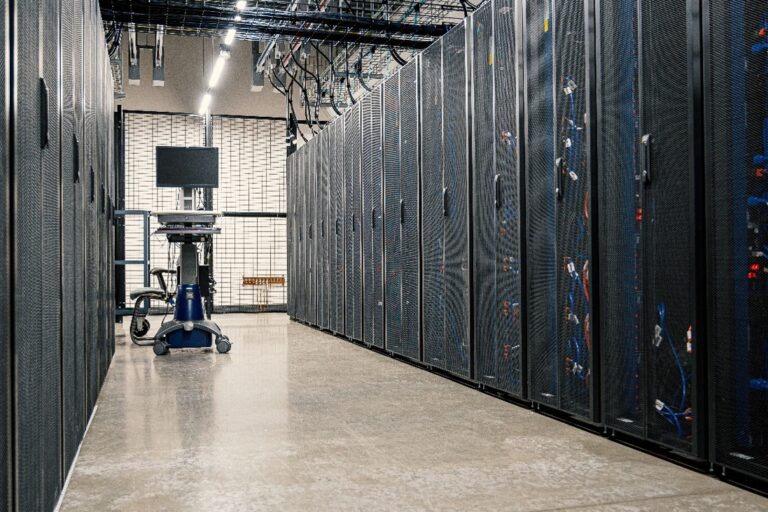
AI data center corridor – Pexels
Data centers can help AI technology’s fast advance, but their rapidly increasing environmental impact must be addressed.
Data centers—server-and-infrastructure-packed buildings popping up nationwide—promise to deliver artificial intelligence services, and with them, the future. But recent headlines show that promise may eat a lot of space—territorial and mental.
Consider the Stratos Hyperscale Data Center, approved against strong public outcry in Utah’s Box Elder County. It would occupy 40,000 acres, or 62 square miles, which KSTU-TV pointed out is about half as large as the state’s capital, Salt Lake City, which covers 110 square miles, and larger than Bryce Canyon National Park, which covers 36,000 acres. Once completed, it would generate and consume more energy than the entire state of Utah—it’s projected 9-gigawatt power capacity is twice that of the state’s current average electricity use of roughly 4 gigawatts.
Backed by Canadian celebrity investor and “Shark Tank” panelist Kevin O’Leary, the project has incensed county residents. The county commission meeting to vote on the project drew so many residents that it had to move to the state fairgrounds. Public outcry was strong. As environmental advocate Caroline Gleich said, “People are concerned about its potential impacts and the lack of transparency in the approval process.”
News coverage shows AI data centers are controversial, and polarizing. Proponents say the projects bring construction activity, tax revenue, and high-paying jobs. Opponents say that jobs after the buildings’ construction are scarce and the finished centers’ environmental threats are lasting and dangerous.
The Technology Behind the Headlines
Data centers are buildings that store the servers, storage systems, and networking equipment underpinning generative AI. More than 4,000 AI data centers are operating, mostly in California, Texas, and Virginia, and 3,000 more are planned or under construction. CNBC reported that Alphabet (Google’s parent), Amazon, Microsoft, and Meta (Facebook, Instagram, and WhatsApp’s parent) have collectively committed to spend nearly $700 billion on data center construction in 2026.
But just how do data centers work? Let’s look: Power and flexibility separate AI data centers from conventional data centers.
Conventional data centers, designed to handle general computing and cloud storage for work documents and streaming video, use central processing units (CPUs). AI data centers, though, require graphics processing units, or GPUs, often in large numbers over large physical areas. AI data centers gauge throughput control and workload needs to pinpoint where resources should go and put them there.
AI data centers’ computing demands, International Business Machines Corp. notes, would overwhelm conventional data centers, which, Cisco Systems notes, may have performance inefficiencies and bottlenecks that can be expensive to correct.
AI data centers also have tensor processing units, TPUs, application-specific circuits that, like GPUs and tens of thousands of other processors and processor cores, quicken deep learning, machine learning (ML), and natural language processing (NLP). TPUs and GPUs also enable edge computing, which processes and stores data in its original network, rather than routing through a centralized server. GPUs divide complicated problems into smaller problems for concurrent solving in what’s called parallel processing. The high-performance computing behind AI executes what’s called massively parallel processing.
AI’s high speed and high computations rely on solid-state drives (a kind of semiconductor-based storage device) and GPUs and accelerators, which deploy high-bandwidth memory. High-bandwidth memory spurs high-performance data transfer with less power than dynamic random-access memory, which powers more pedestrian gadgets—desktop computers and servers, smartphones, and video game systems.
Thirst for Power
As AI data centers grind through advanced computing, networking, and storage, they generate a lot of heat, so advanced systems must power and cool them. This requires vast power.
In a 2025 report abstract, the Paris-based International Energy Agency (IEA) wrote that data center electricity use is on track to account for almost half of US electricity demand growth from now to 2030. The agency says that although a conventional data center draws as much electricity as 10,000–25,000 households, a newer “hyperscale” AI data center (such as the one in Utah) can use 10 times as much—enough to power 100,000 homes.
Meta’s Hyperion data center in Louisiana, for example, once complete, will draw more than twice the power of the entire city of New Orleans. The Congressional Research Service reported that in 2023, US data centers consumed 176 terawatt-hours of electricity (as much as Ireland, the Lincoln Institute notes). And the Lawrence Berkeley National Laboratory projects that AI data center energy use could double or triple by 2028.
After energy comes water. The Lincoln Institute of Land Policy (a Cambridge, Massachusetts, think tank) estimates that some larger AI data centers will need 5 million gallons of water daily. Many researchers have cited the example of a 100-word AI prompt answer spending about one 16-ounce bottle’s worth of water. Business Insider reported that states, fearing water shortages, are renegotiating water allocations guided by the 103-year-old Colorado River Compact.
Potable Water to Fuel Technology Expansion and Job Creation
Nevertheless, proponents of AI data centers argue that the US can’t afford to lose ground in the global AI race and that communities that allow the data centers will have a front seat to drive the future. “Researchers and engineers build the world’s most advanced models (to) test ideas faster, and do it all more efficiently. It’s not just about running AI — it’s about creating it,” Microsoft said of its Fairwater center, one of two Wisconsin projects the company is building.
Microsoft said it hired more than 3,000 workers to build Fairlawn in Mount Pleasant, Wisconsin, one of two Badger State projects, and projected it will support about 800 permanent jobs. As of May 12, the company said it has hired 375 people for full-time positions at the data center. But Wisconsin Watch challenged Microsoft’s counts, reporting that some construction jobs went not to locals, but out-of-towners working in the state temporarily.
The National Security Conversation
As companies tout the benefits of AI’s data centers for American citizens, the US government has been looking at keeping pace in AI technology to counter external threats. Former President Joe Biden’s administration and the current Donald Trump administration have both alluded to a growing threat from AI as a national security concern. Vice President J.D. Vance has said “hostile foreign adversaries have weaponized AI,” and Biden warned of the “use of AI systems by adversaries and other foreign actors.”
Julian Barnes, who covers U.S. intelligence agencies and international security for The New York Times, said in March 2026 that AI has moved from theory to practice, integrating into every aspect of warfare. “AI is deeply embedded in the process of collecting intelligence and using it to shape strategic decisions,” he said.
At an April House Homeland Security Subcommittee on Cybersecurity and Infrastructure Protection, US Reps. LaMonica McIver, D-N.J., and Vince Fong, R-Calif., asked about federally protecting US data centers. UK legislators have done this, declaring data centers critical national infrastructure.
And writing in May 2026 in The Washington Post, David Deptula, a retired US Air Force lieutenant general and Mitchell Institute for Aerospace Studies dean, warned of facing 21st century military competition with a 20th century mindset. “Nearly every function in the military depends on the ability to store, move, process, secure and exploit vast quantities of data at speed and scale,” he wrote. A nation that cannot store and process data will not deter—nor, if necessary, defeat—a peer adversary.”
Deptula added that success in future wars will hinge on which nation can detect and act more quickly, and having the computing capacity to train on AI will matter. “Americans do not want higher utility bills or strain on the environment, nor do they want poorly planned industrial development imposed on their communities without their consultation,” he wrote. “But they also wouldn’t want China to win the AI race or to see US forces outpaced in a fight over the Taiwan Strait.”
Searching for Balance
The International Energy Agency suggested that although data centers use energy, there’s the possibility that they might also save some. “While the increase in electricity demand for data centers is set to drive up emissions, this increase will be small in the context of the overall energy sector and could potentially be offset by emissions reductions enabled by AI if adoption of the technology is widespread,” the agency said, quoting from a report.
And some research is being done to reduce the significant environmental costs of these centers. In June, Nvidia announced a closed-loop liquid cooling system that would lower water consumption needs. But the systems require “favorable climates” so that heat from the cooling liquid can be transferred via outdoor dry coolers to ambient outside air. As Nvidia’s blog states: “A data center in the Scottish Highlands and one in Phoenix, Arizona, face very different realities.” Changes to reduce environmental costs are a step in the right direction, but this solution still only “addresses about a quarter to a third of AI data centers’ total water consumption” while directly adding heat to the area’s air.
As IEA Executive Director Fatih Birol said, “AI is a tool, potentially an incredibly powerful one, but it is up to us – our societies, governments and companies – how we use it.”
US leaders and lawmakers are stepping into the conversation. Sen. Bernie Sanders I-Vt., and Rep. Alexandra Ocasio-Cortez, D-N.Y., have proposed the AI Data Center Moratorium Act, a bill that would pause all new large-scale AI data center construction until Congress can pass AI safety legislation. However, as Endgadget reported, AI companies spent at least $83 million in federal elections in 2025, and Republicans who generally oppose this sort of legislation, control the presidency and both chambers of Congress.
And US citizens continue to make their voices heard. In Utah, residents have objected to the Box Elder County project beyond the recent meeting, at which commissioners voted to let the project proceed. The Salt Lake Tribune reported that after nearly thousands of Utahns complained, an application to divert water from the Salt Wells Spring stream, near the Great Salt Lake, was rescinded. Local residents had long used the stream for irrigation.
“The world does not need more AI data centers,” Brigham City resident Alexis Forsgren wrote in an online response to the data center. “It needs more of us coming together and using our actual brains to solve issues.”
***
Because of the environmental risks and its documented tendency to reinforce ethnic and gender biases or “hallucinate,” i.e., deliver false results, Nova Arc Content Co. uses AI sparingly and thoughtfully. We can explain how these, and other complicated science-related systems work as writers, or refine ideas about them as editors and proofreaders. Schedule a meeting with us to learn about our services.
***
SOURCES
- Bahar, D. and Wright, G. “New Evidence On Data Center Employment Effects.” Brookings Institution. Published May 4, 2026.
- Bennhold, K. “A Fight About the Future of War.” The New York Times. Published March 3, 2026.
- Bhaimiya, S. and Roach, A. “How The Red-Hot AI Data Center Boom Is Igniting Demand For A New, Lucrative Career Path: Trade Workers.” CNBC. Updated April 1, 2026.
- Bryant, C. “Designation of UK Data Infrastructure as Critical National Infrastructure and the Telecoms Supply Chain Diversification Advisory Council Report.” UK Parliament website. Published September 12, 2024.
- Campbell, D. “How Data Centers Are Deepening the Water Crisis.” Business Insider. Published June 24, 2025.
- Cisco Systems. “What Is an AI Data Center?” Cited May 11, 2026.
- City Cast Salt Lake. “Who to Blame for the Data Center, Parks for Mother’s Day, Two-Headed Calf.” Posted May 8, 2026.
- Congress.gov. “Artificial Intelligence Data Center Moratorium Act.” Posted March 25, 2026.
- Data Bank. “Data Centers 101: A Beginner’s Guide To Understanding Core Concepts.” Published May 29, 2024.
- De Chant, T. “Nvidia Wants to Cut Data Center Water Use, but That’s Not the Same as Fixing AI’s Water Problem.” Tech Crunch. Published June 22, 2026.
- Deptula, D. “Blocking the Construction of Data Centers is a National Security Risk.” The Washington Post. Published May 28, 2026.
- Dunlap, M. “Here’s What the Data Center Boom Means for Wisconsin’s Workforce.” Wisconsin Watch. Published March 19, 2026.
- Edelman D. “Interwoven frontiers: Energy, AI, and US-China competition.” Brookings Institution. Published August 11, 2025.
- Edmonds, E. “Kevin O’Leary Defends His Utah Data Center Project: ‘Think About the Number of Jobs.’” Business Insider. Published May 8, 2026.Elias, J. “Tech AI Spending May Approach $700 Billion This Year, But the Blow to Cash Raises Red Flags.” CNBC. Updated February 6, 2026.
- Geyer, G. “Why Data Centers Now Belong On The Critical Infrastructure List.” Cyberscoop. Published May 4, 2026.
- Gibson, M.J. “What’s Up With Mr. Wonderful’s Utah Data Center?” Published May 17, 2026.
- Gorey, J. “Data Drain: The Land and Water Impacts of the AI Boom.” Lincoln Institute of Land Policy.” Published October 17, 2025.
- Institute for Energy Economics and Financial Analysis. Published July 30, 2025.
- International Energy Agency. “AI Is Set to Drive Surging Electricity Demand from Data Centres While Offering the Potential to Transform How the Energy Sector Works.” Published April 10, 2025.
- International Energy Agency. “Understanding the Energy-AI Nexus.” Cited May 11, 2026.
- Jonker, A. and Gomstyn, A. “What is an AI Data Center?” IBM. Cited May 10, 2026.
- Kunkel, C. “Projected Data Center Growth Spurs PJM Capacity Prices By Factor of 10.”
- Lee, N.T. and West, D. “The Future of Data Centers.” Brookings Institution. Published August 11, 2025.
- Lenovo. “What is DRAM?” Cited May 10, 2026.
- Means, S.P. and Larsen, A. “How Do Box Elder County Locals Feel About the Massive Data Center Plan? The Numbers are Overwhelming, Records Show.” Salt Lake Tribune. Published May 11, 2026.
- Microsoft. “Made in Wisconsin: The World’s Most Powerful AI Datacenter.” Published September 18. 2025.
- Mineo, L. “Why Are Communities Pushing Back Against Data Centers?” Harvard Gazette. Published April 9, 2026.
- Nutanix. “What is Edge Computing?” Cited May 11, 2026.
- Parker, J. “Hotter Than a Hot Tub: The 45°C Breakthrough to Cool AI’s Biggest Machines.” Nvidia. Published June 21, 2026.
- Randstad. “U.S. Demand For Skilled Trades Grows 3x Faster Than Professional Roles.” Published March 26, 2026.
- Roth, M. “Just How Big Is The Proposed Box Elder County Data Center? This Big.” Published May 5, 2025. KSTU-TV. Published May 8, 2025.
- Schulz, J. “Microsoft Says It Has Hired Around 375 People for Its Mount Pleasant Data Center.” Wisconsin Public Radio. Published May 12, 2026.
- Shanklin, W. “Sanders And Ocasio-Cortez Introduce a Bill to Pause US Data Center Construction.” Engadget. Published March 26, 2026.
- Tomás, J.P. “AI Data Center vs. Traditional Data Center – What Is The Difference?” RCR Wireless News. Published March 27, 2025.
- Verma, P. and Tan, S. “A Bottle of Water per Email: The Hidden Environmental Costs of Using AI Chatbots.” The Washington Post. Published September 18, 2024.
- Wilkins, J. “JPMorganChase Data Center Gets $77 Million Handout to Create Grand Total of One Job.” Futurism. Published April 21, 2026.
- Wilkins, J. “You’ll Never Guess Trade Unions’ Position on AI Data Centers.” Futurism. Published May 7, 2026.
- Yañez-Barnuevo, M. “Data Centers and Water Consumption.” Environmental and Energy Study Institute. Published June 25, 2025.