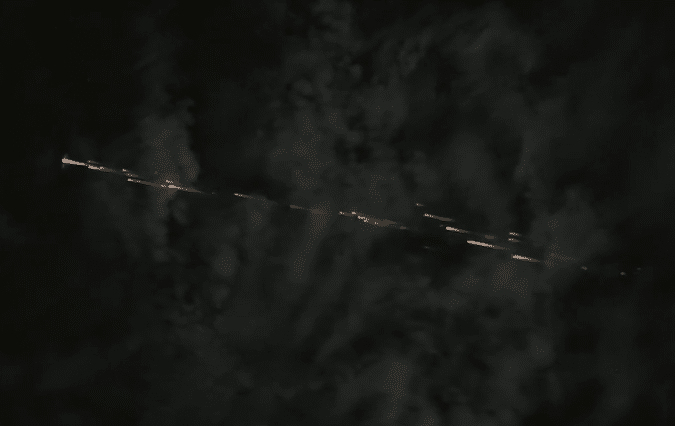
NASA astronaut Chris Williams, aboard the International Space Station for Expedition 74, photographed what was likely orbital debris reentering Earth’s atmosphere in April – astro_chrisw, Instagram
Satellite pieces, rocket parts, and other debris are crowding low-Earth orbit.
Flotsam. Jetsam. Detritus. Debris. Earth’s low orbit is filling with rocket and satellite fragments—“space junk,” colloquially. Observers agree there’s a lot of it, though its definition is wide.
With space back in the headlines, courtesy of NASA’s April 2026 Artemis II mission, space junk stories have also amassed, floating through newsfeeds like debris through space. This junking began in 1957, when the Soviet Union launched the Sputnik satellite, touching off the 1950s–1960s US–USSR space race.
European Space Agency statistics show that there is now 2,700 dead satellites and 54,000 larger-than-a-golf-ball objects orbiting Earth. Popular Science magazine reports that millions of centimeter-and-larger objects and about 130 million tinier space trash fragments are orbiting Earth. Acta Astronautica, a peer-reviewed scientific journal, reported in January 2026 that objects stuck in low Earth orbit have increased 76% from 2019 (13,741) to 2025 (24,185). The US has likely worsened space junk proliferation, having launched 3,708 objects into space in 2025, up from 984 in 2020.
And once they’re up there, these things tend to stay…until they don’t. The European Union Space magazine Horizon reported that although some space satellites burn up after falling back to Earth, others can stay suspended for years, or decades. As April 2026 ended, Chris Williams, a NASA astronaut aboard the International Space Station photographed what was probably a flaming space junk fragment zipping by and disintegrating as it entered Earth’s atmosphere. “It was quite a light show!” Williams wrote on Instagram.
And with this much junk, crashing is expected. Hugh Lewis, an astronautics professor at the University of Birmingham in England, told Space.com that there is a 10% chance that some of those orbiting objects collide within a year. Some efforts to clear this flotsam have created more mess. In 2021, for example, a Russian missile launched to destroy an old satellite created 1,500 new trackable bits of orbital wreckage. In 2009, two Russian satellites—one active, one decommissioned—collided, creating 2,000-plus new pieces of debris.
Experts have said a chain of debris collisions, called Kessler syndrome, could spark a hard-to-stop chain reaction that could make large areas impassible. (Donald Kessler, a researcher in NASA’s Environmental Effects Office at Houston’s Johnson Space Center described these potential collisions in a 1978 paper in the Journal of Geophysical Research.)
Call for cleanup
In 2023, the Federal Aviation Administration, under President Joe Biden, proposed shortening the window for operators to remove defunct satellites from orbit from 25 years to 5, arguing that the unchecked accumulation of orbital debris would needlessly clutter orbits for human spaceflight and for communications, weather, and global positioning system satellites.
The plan would move upper stages of launched projectiles, mainly rockets, to a “graveyard orbit” and send the upper stages on an Earth-escape orbit. When it made the rule, the FAA said clearing space clutter would mitigate risk on Earth, because some space debris had fallen to Earth every day for the previous 50 years.
If satellite junk wasn’t enough, there’s junk from rockets, which break apart in flight. But in March 2026, President Donald Trump’s administration retreated from a mandated 25-year window for removing rocket parts from Earth’s orbit. Explaining his rationale, Trump issued an executive order in August 2025, arguing that too many rules hamper the US’ space exploration. “Inefficient permitting processes discourage investment and innovation, limiting the ability of US companies to lead in global space markets,” the order read. “Overly complex environmental and other licensing and permitting regulations slow down commercial space launches and infrastructure development.”
News outlets noted that this move would benefit commercial space operators, including Elon Musk’s SpaceX and Jeff Bezos’ Blue Origin, companies whose founders have both donated to Trump, with Musk donating at least $250 million to Trump’s 2024 presidential campaign and Bezos donating $1 million to Trump’s inauguration fund and spending $75 million through Amazon on the Melania documentary film.
Trump’s space rules rollback dismayed Ewan Wright, a University of British Columbia doctoral candidate and Outer Space Institute junior fellow. “Instead of requiring companies to responsibly dispose of these upper stages, the US has decided to roll the dice on a person or a plane getting hit by falling debris,” Wright told ProPublica, adding that US rocket companies in the past five years have abandoned 41 upper-stage rockets in orbit.
Scientific sweep
Scientists and science-minded companies have been exploring how to mitigate all of this space junk. Horizon reported that through a 2025 project called Dexter, scientists from the UK, Estonia, Sweden, and Spain are determining whether the old satellites, made from aluminum and other useful materials, can perhaps be disassembled and reassembled into new frames to support in-use satellites. A more complicated idea would be converting the old satellites into fuel. Robotic arms could catch the satellites, use lasers could cut them open, and the aluminum could then be converted to plasma to power ion thrusters, spacecraft-propelling engines running on charged particles.
Leonard Felicetti, lead on Dexter and an associate space engineering professor at the UK’s Cranfield University, told Horizon, “We are cluttering space with new objects. What we want to do is to try and reuse the material that is already there.”
In 2021, Japan’s Astroscale introduced ELSA, short for End of Life Services, a spacecraft that uses magnets to snatch up defunct satellites and clear them from Earth’s orbit. The company’s UK unit, Astroscale Ltd., said in March that it will use Isar Aerospace to launch a demonstration mission to capture a decommissioned Eutelsat OneWeb satellite. Space News said the launch is slated for Astroscale’s 2028 fiscal year, which begins in May 2027. The European Space Agency, in May 2022, gave Astroscale $16 million toward the launch.
Even with these projects, space junk will likely be a lingering problem. Acknowledging this, Purdue University researcher Carolin Frueh and doctoral student Pavithra Ravi have used machine learning to predict collision probabilities for low-Earth orbit satellites. Frueh is also researching how to use sunlight to detect satellites’ physical orientation in space, which could help get them out of orbit before they get stuck and become junk.
Frueh has said the method would be cheaper than radar; it would deliver information about any satellites that reflect light toward a telescope on the ground. This would be true however far the satellites are from Earth. “The better we know about the pieces we’re dealing with—what’s the shape, how much rotation they have—the better we can execute missions to remove those pieces,” Frueh said.
***
If you have ideas floating around ready for launch, technical copy that could use fine-tuning, or a project that just needs a final polish, Nova Arc Content Co. stands ready. We can write, edit, consult, proofread, format, and partner to deliver impactful, meaningful work. Connect with us to see how we can help move your words forward.
SOURCES
- Aghomo, O. “As Commercial Space Industry Soars, Experts Worry Regulation Is Sliding Backward.” Reporting Texas. Published May 5, 2026.
- Albert, K. “Limiting Space Junk’s Threat By Predicting Its Mess In The Earth-Moon Neighborhood.” Purdue University News. Published March 26, 2026.
- Astroscale. “Astroscale Selects Isar Aerospace to Launch ELSA-M In-Orbit Demonstration Mission.” Published March 16, 2026.
- Dinner, J. “Japan’s Astroscale Has a New Robot Tug to Clean Up Space Junk. Here’s How It Works.” Space.com. Published June 13, 2023.
- Foust, J. “Astroscale selects Isar Aerospace to launch ELSA-M mission.” Space News. Published March 13, 2026.
- Federal Aviation Administration. “FAA Proposed Rule Would Reduce the Growth of Debris from Commercial Space Vehicles.” Published September 20, 2023.
- Grant, B. “Space Is Raining Junk, and It’s Getting Worse.” Nautil.us. Published October 21, 2025.
- Jones, A. “Space Junk Cleanup Tech That Could ‘Shepherd’ Debris Into Earth’s Atmosphere Gets US Patent.” Space.com. Published August 5, 2025.
- Kelvey, J. “Understanding the misunderstood Kessler Syndrome.” Aerospace America. Published March 1, 2024.
- Kim, J. and Allyn. B. “Tech moguls Altman, Bezos and Zuckerberg donate to Trump’s inauguration fund.” NPR. Published December 13, 2024.
- Lagatta, E. “NASA Astronaut Spots Fiery Debris from ISS. ‘Quite a Light Show!’” USA Today. Published May 5, 2026.
- Landymore, F. “Trump Rips Up Environmental Rules Protecting Wildlife From Destructive Rocket Launches.” Futurism. Published August 14. 2025.
- O’Callaghan, M. “Rethinking Space Junk in an Age of Satellite Overload.” Horizon magazine. Published April 7, 2026.
- National Aeronautics and Space Administration. “Sputnik: The 50th Anniversary.” Cited April 14, 2026
- Parker, W.E., Harris, M., Lavezzi, G., and Linares, R. “Constraining Earth’s Orbital Capacity Via Operational Feasibility.” Acta Astronautica. Published January 2026.
- Paul, A. “Some Space Junk Just Got Smacked by More Space Junk, Complicating Cleanup.” Popular Science. Published August 25, 2023.
- Paul, A. “The FCC Is Finally Pulling The Reins On Space Junk.” Popular Science. Published September 21, 2022.
- PBS News. “Musk Says He Will Cut Back On Political Spending After Paying At Least $250M Backing Trump in 2024.” Published May 20, 2025.
- Pultarova, T. “Is Low Earth Orbit Getting Too Crowded? New Study Rings an Alarm Bell.” Space.com. Published October 13, 2025.
- Rainbow, J. “Astroscale Gets Funds For 2024 Debris-Removal Mission.” Space News. Published May 27, 2022.
- Superville, D. “Melania Trump’s Documentary Premieres at the Kennedy Center Ahead of Global Release.” The Associated Press. Published January 29, 2026.
- The White House. “Fact Sheet: President Donald J. Trump Enables Competition in the Commercial Space Industry.” Published August 13, 2025.
- The White House. “Executive Order: Enabling Competition In The Commercial Space Industry.” Issued August 13, 2025.
- Vogell, H. “Amid Crowded Skies, FAA Kills Rule Aimed at Regulating Space Junk.” ProPublica. Published March 12, 2026.