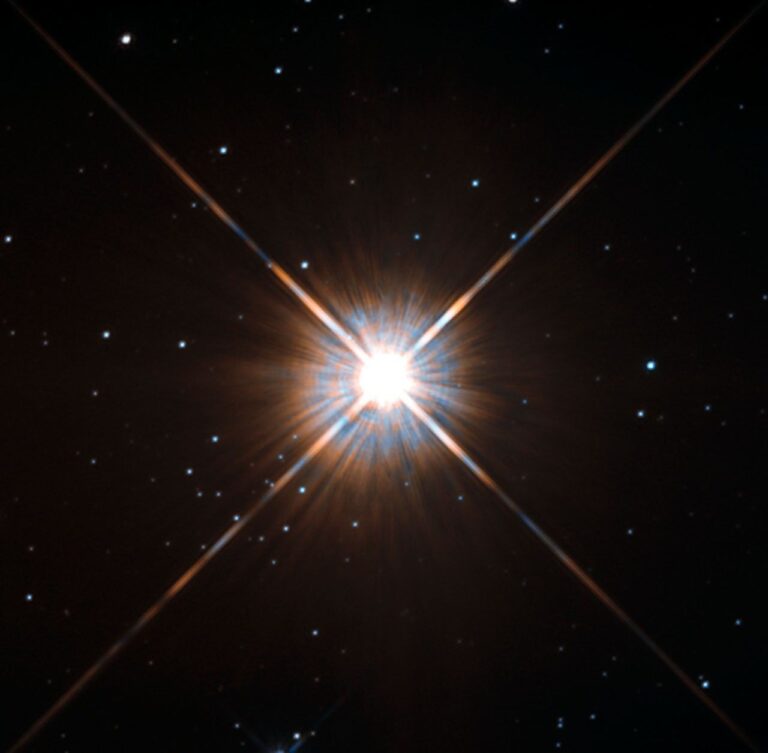
The red dwarf star Proxima Centuari. – ESA/Hubble and NASA
International nonprofit directs naming for the stars, planets, and comets.
— Lynxpardinus, as in the Iberian lynx, which was once the world’s most endangered feline but has rallied to symbolize successful wildlife conservation.
— Akabeko, as in “red cow,” a traditional folk toy from Japan’s Aizu region. By regional legend, a red-haired cow appeared whenever disease ran rampant to absorb the infection and save the people.
— Pikador, as in the České Budějovice term for a specific street food hot dog—a bread roll with its end cut off and a cooked sausage placed inside. (Yum.)
These might seem like random answers for a pub trivia night. (Nova Arc’s crew is always preparing.) But they’re among 69 newly issued minor-planet names, as outlined in the International Astronomical Union’s June 2026 bulletin.
The Paris-based International Astronomical Union, since its 1919 founding, has been the official celestial objects namer, overseeing nomenclature for planets, stars, planetoids, and comets. The United Nations issued a resolution in 1982 recognizing this authority.
Through international cooperation, the nonprofit has promoted and safeguarded astronomical research, education and development, and communication. The group’s 12,742 members, from 92 nations, are professional astronomers and doctoral researchers who research, teach, and promote astronomy. Within the union, working groups oversee naming for different celestial bodies, such as stars, planetary systems, exoplanetary systems, and small bodies. The union has 48 working groups.
Here’s a closer look at some working groups and their naming criteria.
Planets: As the Planetary Society, a nonprofit chaired by Bill Nye (“The Science Guy”) and started partly by “Cosmos” author Carl Sagan, reported, long before the union intervened, some heavenly bodies people could see without telescopes got names—the Earth, the sun, the moon.
The next to get names, also because of naked-eye visibility, were solar system planets: Jupiter, Mars, Mercury, Saturn, and Venus. These names, the society said, were linked to mythology. In some Asian languages, the society said, names correspond with the five elements—Mars (fire), Mercury (water), Jupiter (wood), Saturn (earth), and Venus (metal).
NASA scientist Henry Throop said early astronomers gave the planets names of Roman gods because they were writing in Latin and Latin was the Romans’ language. As the Planetary Society noted, the names also followed a Greek tradition that paired planets with the mythological gods’ characteristics. The planet crossing the sky most quickly took the name of the Olympian messenger; the red planet took the raging war god’s name.
When astronomers, aided by telescopes, began spotting things like moons and far-off Uranus, they wanted to name them after sponsors, the Planetary Society reported. Galileo Galilei, for example, discovered Jupiter’s four major moons in 1610, and proposed naming them for members of the Medici family. After finding several Saturn moons in the late 1600s, Giovanni Domenico Cassini called them Sidera Lodoicea (“Stars of Louis”) to honor France’s King Louis XIV. William Herschel discovered Uranus in 1781 and proposed naming it for George III, the British king.
But Roman mythology won out again. Simon Marius, who observed Jupiter’s moons when Galileo did, but published his findings later, in 1614, proposed naming these moons, at fellow astronomer Johannes Kepler’s behest, after Jupiter-adjacent characters—
Callisto, Europa, Ganymede, and Io. Saturn’s moons took names of siblings of Kronos (the Greek Saturn). Uranus’ name is a variation of Ouranos, the Greek sky god. (Some of the Greek gods, notably gray-eyed Athena, are having a Hollywood moment this month as “The Odyssey” opens in cinemas nationwide.)
Pluto was named for a Roman god, too, although it ceased to be a planet in 2006. The union defined these planethood criteria: A celestial body that (a) is in orbit around the Sun, (b) has sufficient mass for its self-gravity to overcome rigid body forces so that it assumes a hydrostatic equilibrium (nearly round) shape, and (c) has cleared the neighborhood around its orbit.
“Pluto does not meet these criteria,” the union wrote in a data sheet, “and it is therefore not a planet. Pluto is instead a dwarf planet.”
Comets: The union said comets began taking their discoverers’ names in the 20th century; before that, short-period comets, ones that orbit the sun in less than 200 years, generally took names after their second apparition, or appearances in the sky. Single-apparition comets or long-period comets, ones that take more than 200 years to orbit the sun, took names or designations, often parenthetically, but the system was neither formal nor consistent.
In 2003, after several night-sky-mapping studies using charge-coupled device-equipped cameras, the union revised its comets naming system. The union said it announces comet names after a reasonable orbit has been determined, to keep lost comets from getting renamed. The union’s Minor Planet Center consults with the Small Bodies Network Working Group’s Comet Names subcommittee to determine comet names. If the
subcommittee cannot agree on a name, the working group intervenes.
Whenever possible, the union said, comets will take their discoverers’ surnames. If there is more than one discoverer, the comet can take up to three surnames. If two (or more) independent discoveries of a comet, discoverers (or teams’) surnames will be listed in chronological order of discovery. If, as sometimes happens, a very bright comet suddenly appears, visible to the naked eye by many people, comets will receive generic names, such as “eclipse comet” or “great comet.”
Stars: The union said the stars working group arose from an astrophysics need to standardize star names for international research papers. Most commonly used spellings were standardized from 2015 to 2021.
The group says it chooses names based on historical significance, cultural heritage, and long-standing astronomical traditions. “The aim is to honor the rich diversity of how different cultures have named the stars, while maintaining clarity and avoiding confusion or offense.”
The working group names visible stars (brighter than 6.5 magnitude), using names of historical and indigenous asterisms (stars, star-asterisms, constellations, and superconstellations). To make these decisions, the group consults anthropological, ethnological, historical, and cultural researchers.
Public NameExoWorlds campaigns, part of a global public outreach project, determine names of stars fainter than 6.5 magnitude (ones people can’t see unaided). The working group and the Office for Astronomy Outreach run the campaigns.
Exoplanets: In 2013, the union’s planets and satellites working group partnered with Zooniverse, a citizen science project, to run its first public campaign to help name exoplanets. The partners collected suggestions from astronomy clubs and astronomy-adjacent nonprofits and then allowed a public vote through NameExoWorlds.
Other exoplanets named in the June roundup took people’s names:
— Takuda for Kazuki Tokuda, a Japanese astronomer and lecturer in radio astronomy at Kagawa University
— Hélènecourtois, for French astrophysicist and university professor Hélène Courtois, who mapped large-scale gravitational flows and co-discovered the Laniakea supercluster.
— Kianamcfadden for Kiana McFadden, an American planetary scientist who uses data from multiple observatories, to study asteroids’ physical and dynamical properties. (McFadden earned her doctorate in planetary sciences in 2026 from the University of Arizona.)
NASA’s Throop, meanwhile, in a video posted on YouTube, said people will probably keep naming heavenly bodies as long as we can see them.
“Because we’re humans, we want to name these things. It gives us a connection to the huge universe around us,” he said. “Thousands of years from now, people are still going to be naming planets, as we continue to explore the world around us.”
***
Have a project ready for launch? Nova Arc can write, edit, proofread, or format it. Schedule a meeting with us or check out our services.
SOURCES
-
- Big Cat Sanctuary. “A Guide to the Iberian Lynx.” Cited July 13, 2026.
-
- Candlewick Press. “Galaxy Mapper: The Luminous Discoveries of Astrophysicist Hélène Courtois.” Cited July 13, 2026.
-
- Dyson, L. “Returning Comets: A Guide To Short-Period Comets (In Pictures).” BBC Sky at Night Magazine. Published July 26, 2021.
-
- European Southern Observatory. “Naming of Astronomical Objects.” Cited July 1, 2026.
-
- European Southern Observatory. “Executive Committee WG Planetary System Nomenclature (WGPSN) — Functional.” Cited July 9, 2026.
-
- Furfaro, E. “How Do Planets Get Their Names? We Asked a NASA Scientist.” National Aeronautics and Space Administration. Published July 26, 2023.
-
- Howells, K. “How do things in space get their names?” The Planetary Society. Published April 23, 2026.
-
- International Astronomical Union. “Working Group for Small Bodies Nomenclature Bulletin.” Published June 16, 2026.
-
- Japan National Tourism Organization. “An Ode to Akabeko: On Bobblehead Cows, and Rural Plight.” Published May 14, 2022.
-
- International Astronomical Union. “Frequently Asked Questions.” Cited July 9, 2026.
-
- NameExoWorlds. “2022 Overview.” Published December 11, 2022.
-
- NameExoWorlds. “Naming Rules.” 2022 Edition.
-
- National Aeronautics and Space Administration. “Harry Throop, Ph.D., Bio.” Cited July 9, 2026.
-
- National Aeronautics and Space Administration. “Moons of Jupiter.” Cited July 2, 2026.
-
- National Aeronautics and Space Administration. “How Do Planets Get Their Names? We Asked a NASA Expert.” YouTube. Published July 26, 2023.
-
- ResearchGate. “Kazuki Tokuda.” Cited July 13, 2026.
-
- SpaceNews. “NameExoWorlds – An IAU Worldwide Contest to Name Exoplanets and Their Host Stars.” Published July 9, 2014.
-
- The Planetary Society. “About Us.” Cited July 1, 2026.
-
- United Nations. “Fourth United Nations Conference on the Standardization of Geographical Names.” Published August 24, 1982.
-
- University of Arizona Lunar and Planetary Laboratory. “Kiana McFadden Bio.” Cited July 13, 2026.
-
- U.S. Geological Survey. “Categories (Themes) for Naming Features on Planets and Satellites.” Cited July 1, 2026.
-
- U.S. Geological Survey. “International Astronomical Union Rules and Conventions.” Cited July 1, 2026.
-
- U.S. Geological Survey. “International Astronomical Union Working Group for Planetary System Nomenclature.” Cited July 1, 2026.
-
- Zooniverse. “What is the Zooniverse?” Cited July 1, 2026.