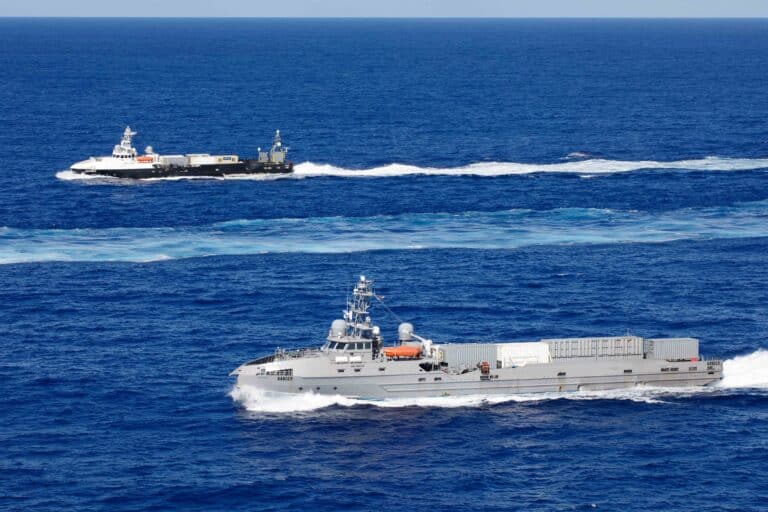
Explore the abundance of terms being used to describe the evolving technology.
What exactly are drones? Are they for land? Or sea? Are they amphibious? Do they fly, or float, or sink? Yes, to all of the above. People use flying drones to deliver packages, take epic selfies, create light shows, track and map storms, and fight wildfires. People also use the term “drone” broadly, but as the technology adds capabilities and shifts shapes and functions, the language for describing it has become complex and important to understand.
For example, “autonomous” and “uncrewed” (or “unmanned”) are not equivalent terms. “Uncrewed” means nobody’s aboard; people are working with the drone somewhere, determining flight paths and direction. Autonomous systems can make decisions on their own, powered by computer programming or artificial intelligence. A vessel may be uncrewed but not autonomous, for example, if it is remotely controlled. The International Maritime Organization’s “four degrees of autonomy” framework reflects this distinction where a “Degree Three” ship is remotely controlled from another location with no seafarers onboard; a “Degree Four” ship is fully autonomous with an operating system that “can make decisions and determine actions by itself.”
The term “unmanned” benefits from both historical and widespread use, but it lacks precision—after all, an unmanned system still relies on a person operator somewhere in the process. Because its gender-neutral synonym “uncrewed” retains the same issues, there’s been hesitation by some to adopt it. But the use of “uncrewed” has taken hold among organizations—NOAA, the Department of Defense, NASA, and NATO, to name a few—fueled by increasing requests for this change, the growing audience for aerospace, and efforts to deepen inclusion. “Unmanned” and its synonym “uncrewed” are both readily understood and increasingly often are used interchangeably.
From Conflict Comes Change
The Ukraine-Russia war has played a significant role in the evolution of both drones and their definitions. In February 2022, after Russian troops invaded, Ukraine led front-line, deep-strike attacks with swarms of first-person-view (FPV) drones, which are radio-controlled, high-speed, often camera-equipped quadcopters. The Ukrainians would later use sea drones, uncrewed surface vessels, to strike Russian ships and offshore infrastructure in the Black Sea. Small drones controlled by optic fibers also became commonplace because of their immunity to electronic warfare countermeasures. By November 2025, nonprofit news organization The Conversation described 14 kinds of drones that had been involved in the Ukraine and Russia war. They include:
Multicopter drones: General-purpose drones for battlefield reconnaissance, GPS jamming, hostile drone intercepting, small mine and bomb dropping, electronic warfare, and communications relay.
Aircraft-style drones: Reusable one-way drones in two varieties, kamikaze and loitering. Used in long-range strikes on cities targeting infrastructure and transport.
Counterdrones: Amalgamations of gun systems, electromagnetic pulse systems, surface-to-air missiles, and backpack and vehicle-mounted electronic jammers.
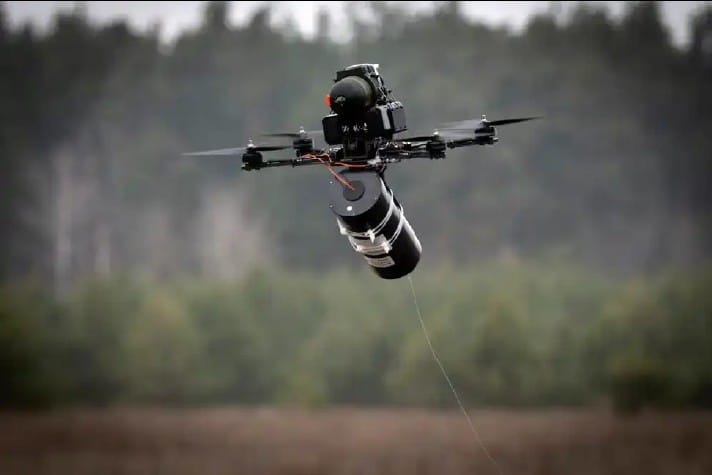
Fiber optic drones have become commonplace in the war between Ukraine and Russia. (Photo by U.S. Army Europe-Africa)
Structurally speaking, “drones” can be small quadcopters or aerial commercial vehicles; they can be ground-based wheeled robots like the ones delivering food across college campuses; or they can be the US Navy’s new 240-metric-ton autonomous ship. The Center for New American Security, a think tank, breaks drones into three categories: hobbyist, midsize military and commercial drones, and large military-specific drones.
This brings us to the alphabet soup of terminology describing drones. Gimme a U! And an A! And an S and a V! What’s that spell? It depends.
What Do A, S, U, V and All Those Other Drone Terms Mean?
Adding to the confusion around drone terms are the letters A, S, U, and V. Although commonly used in the acronyms that describe the different types of drones, all four letters might mean at least three or more different things themselves. For example, what’s the difference between AUV and UAV?
A: Aerial, aircraft, autonomous, air, or altitude
S: System, surface, subsurface, solar, satellite, or small
U: Uncrewed, unmanned, undersea, or underwater
V: Vehicle, vessel, or view
AUV: Autonomous undersea/underwater vehicle: Alternate name for uncrewed underwater vehicle that is operated remotely and tether-free. Useful for underwater mapping and detecting and surveying submerged objects, such as wrecked ships.
FPV: First-person-view: A camera-equipped drone that delivers video, giving the on-the-ground pilot an in-the-flight-deck experience. Some racing varieties of FPVs can fly faster than 80 miles per hour.
HAPS: High-altitude pseudo-satellite: Drone that flies at very high altitudes for long durations.
LRAUV: Long-range AUV: Uncrewed underwater vehicle/vessel designed to explore upper-ocean space and last for long periods. Because these craft have ultralow energy transit modes, they can run without support ships’ aid.
MAV: Micro air vehicle: A drone small enough to fit in a palm.
ROAV: Remotely operated aerial vehicle: Similar to UAV; often used in specific industries.
ROV: Remotely operated underwater vehicle/vessel: This underwater drone is connected by tethers to other crafts and piloted by people.
ROUV: Remotely operated underwater vehicle: An alternative name for an ROV.
RPA: Remotely piloted aircraft (alternative definition for UAV): Often used in commercial duties.
RPAS: Remote-piloted aircraft system.
SAUV: Solar autonomous underwater vehicle: It uses visible light, particularly in the spectrum’s green to blue regions, for energy.
UAS: Uncrewed aircraft system: Combination of an UAV (defined later) and its ancillary equipment such as ground control and GPS modules, cameras, software, transmission systems, and human operators.
sUAS: Small uncrewed aerial system.
UAV: Uncrewed aerial vehicle: Note that UAV refers only to an airborne drone itself, but not its ancillary accessories and equipment.
UCAV: Uncrewed combat air vehicle: A drone designed to carry weapons.
UGV: Uncrewed ground vehicle: First developed by DARPA, part of the Department of Defense, in the 1980s.
USV: Uncrewed surface vehicle/vessel: Remotely operated vessels operating on water surfaces.
UUV: Uncrewed underwater vehicles/vessel: Used on coasts and open sea. Piloted through sensor-responsive directives in the deep and perhaps GPS near the surface.
UV: Underwater vehicle, or uncrewed underwater vessel/vehicle: In some cases, the UV can stand for ultraviolet. Drones equipped with UV-C lights, for example, deliver high-energy electromagnetic radiation at 180- to 280-nanometer-width wavelengths to disinfect surfaces and water.
UVS: Uncrewed vehicle system: These are systems driving uncrewed vehicles through physical spaces.
UxS: Uncrewed system: Umbrella term for all types of drones. In some instances, the x can stand for experimental.
UxV: Uncrewed vehicle: Alternate umbrella term for all types of drones. In some instances, the x can stand for experimental.
***
Whether your project is meant for air, land, water, or space, Nova Arc stands ready to help you spell out your themes and deliver your message. Contact us to arrange a meeting and share your vision, and explore our services and our work.
Sources
· Austin, J. “The Best Drones for Photos and Video.” The New York Times Wirecutter. Published September 22, 2025.
· BAE Systems. “What Are Autonomous UUVs?” Cited February 10, 2026.
· Britzky, H., and Khurshudyan, I. “US Drone Dilemma: Why the Most Advanced Military in the World Is Playing Catchup on the Modern Battlefield.” CNN. Published September 15, 2025.
· Bronk, J. “America’s Drone Delusion.” Foreign Affairs. Published December 15, 2025.
· Chung, T. “DJI Reveals New FPV (First-Person View) Racing Drone that Can Hit 87 Mph, Here’s an Early Review.” TechEBlog. Published March 2, 2021.
· Civil Aviation Safety Authority (Australia). “Types of Drones.” Cited February 10, 2026.
· Cornell University Office of Risk Management and Insurance. “Drones/UAV/UAS.” Cited February 9, 2026.
· Defense Advanced Research Projects Agency. “DARPA Christens Unmanned Ship Aimed at Revolutionizing Naval Capability.” Published Aug. 11, 2025.
· de Havilland Aircraft Museum. “de Havilland DH82B Queen Bee Explainer Page.” Cited December 10, 2025.
· Drone Flyers. “Unmanned Vehicle System.” Cited February 10, 2026.
· Durbin, D. “Delivery Drones May Soon Take Off in the US. Here’s Why.” The Associated Press. Published August 12, 2025.
· Epstein, J. “Unjammable Drones Are Leaving Wires Everywhere, Forcing Ukrainian Troops to Move With Caution.” Business Insider. Published December 2, 2025.
· Federal Aviation Administration. “What to Know About Drones.” Published January 14, 2025.
· Federal Aviation Administration. “What Is an Unmanned Aircraft System (UAS)?” Cited February 9, 2025.
· Federal Register. “Spectrum Rules and Policies for the Operation of Unmanned Aircraft Systems.” Published January 8, 2025.
· Garrow, M., and Lucy, M. “A Visual Guide to 14 of the Drones Wreaking Havoc in Ukraine, Russia and Beyond.” The Conversation. Published November 11, 2025.
· Joseph, J. “Grubhub Is Bringing Autonomous Delivery Robots to More College Campuses.” PC Mag, Published January 31, 2025.
· Jouav. “What Is an FPV drone? The Complete Guide (2026).” Cited February 10, 2026.
· Lewis, D. “The First Delivery Drone in the United States Lands a Spot at the Smithsonian.” Smithsonian Magazine. Published May 2, 2016.
· Marino, C. “Send in the Drones.” US Army Website. Published October 17, 2024.
· Merriam-Webster. “Drone Definition.” Cited December 15, 2025.
· Merriam-Webster. “Rotorcraft Definition.” Cited December 10, 2025.
· McKinney, A. “Complete List of UAV Terms You Need to Know.” UVT. Published July 22, 2020.
· Michel, A. H. “The Center for the Study of the Drone, Out of the Shadows: The Strange World of Ground Drones.” Bard College. Published November 3, 2013.
· Monterey Bay Aquarium Research Institute. “Long-Range AUV.” Cited February 20, 2026.
· Mukhina, O. “Russia Shows New Drone that Looks Like Ukraine’s AI-Guided Sting Interceptor Tested in Denmark.” Euromaidan. Published August 10, 2025.
· Muller, J. “Drones Will Soon Be Everywhere, as U.S. Seeks to Lead Future Of Aviation.” Axios. Published June 11, 2025.
· National Aeronautics and Space Administration. “Style Guide for NASA History Authors and Editors.” August 2012.
· National Ocean Service. “What Is the Difference Between an AUV and a ROV?” Cited February 10, 2026.
· Newton, M. “How Are Drones Changing War? The Future of the Battlefield.” Center for European Policy Analysis. Published November 3, 2025.
· New York University Tendon School of Engineering. “Under the Sea: Can Solar-Powered Underwater Vehicles Help Us Better Understand Our Oceans?” Published August 31, 2023.
· NOAA Boulder. Ask a Scientist. “What Are Drones?” Cited December 10, 2025.
· O’Donnell, J. “The US May Be Heading Toward a Drone-Filled Future.” MIT Technology Review. Published September 30, 2025.
· Panella, C. “America’s Biggest Defense Contractors Are Fighting for Their Place in the Future of Drone Warfare.” Business Insider. Published December 5, 2025.
· Piesing, M. “The Secret History of Drones.” National Air and Space Museum. Published September 23, 2024.
· Pilot Institute. “Drone Lingo Simplified: Acronyms Every Pilot Needs to Know.” Published March 6, 2025.
· Pilot Institute. “What’s the Difference Between Drones, UAV, and UAS? Definitions and Terms.” Published March 22, 2020.
· Price, T., and R. Klein. “The 9 Robot Toys for Kids that Make Stem Learning Fun.” Popular Mechanics. November 26, 2025.
· Roblin, S. “New Defense Department Policy: “Unleashing” Small Drones, Cutting Regulations.” Inside Unmanned Systems.” Published July 14, 2025.
· Roddy, B. “Inside the Vortex: How a 3D-Printed Drone Captures Unprecedented Data.” KWTV-TV (Oklahoma City). Published March 25, 2025.
· Science Direct. “Unmanned Aerial Vehicle.” Cited February 9, 2026.
· Science Direct. “Unmanned Ground Vehicles.” Cited February 9, 2026.
· Sea Machines. “Autonomous Systems vs. Unmanned Vessels and Drones.” Published September 16, 2022.
· Senkosky, E. “How Drones and AI Are Changing the Way We Fight Wildfires.” Grist. Published September 9, 2025.
· Smith, J. “Does Europe Need a Drone Wall?” Chicago Council of Global Affairs. Published November 18, 2025.
· Spencer, M. “Denver’s Daily Holiday Drone Show: Where to Watch, What to Expect.” CBS News. Published December 9, 2025.
· Taygami, T. “Some Georgia Walmart Stores Piloting Drone Delivery This Holiday Season.” Savannah Morning News. Published December 4, 2025.
· U.S. Council on Foreign Relations. “Demographics of the U.S. Military.” Published July 13, 2020.