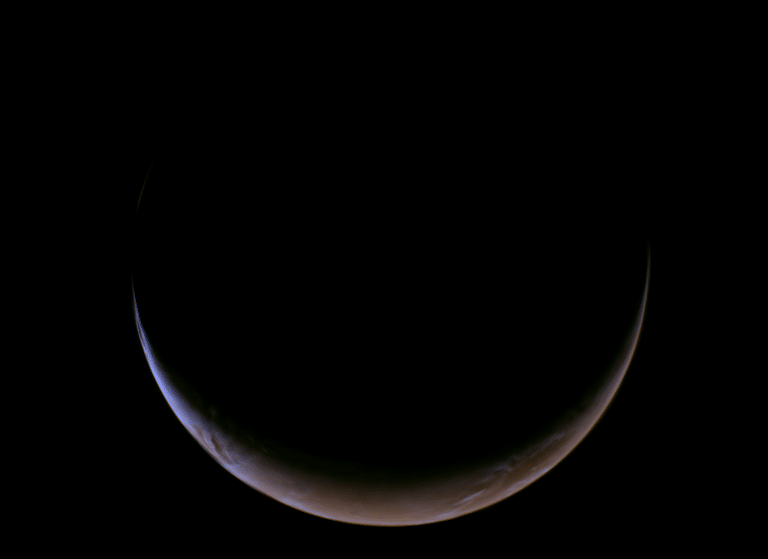
NASA Psyche Probe captured a photo of a crescent Mars on May 15, 2026 – NASA/JPL-Caltech/ASU
The Psyche mission used Martian gravity and a slingshot maneuver to boost speed in space on its way to its namesake asteroid.
“Step up, step up, step up the sky is open-armed
When the light is mine, I felt gravity pull.” — R.E.M., circa 1985
A NASA space probe will not only feel, but use, gravity’s pull on its way to Psyche, an asteroid parked in the belt between Mars and Jupiter. Psyche’s trip will last six years and traverse 2.2 billion miles.
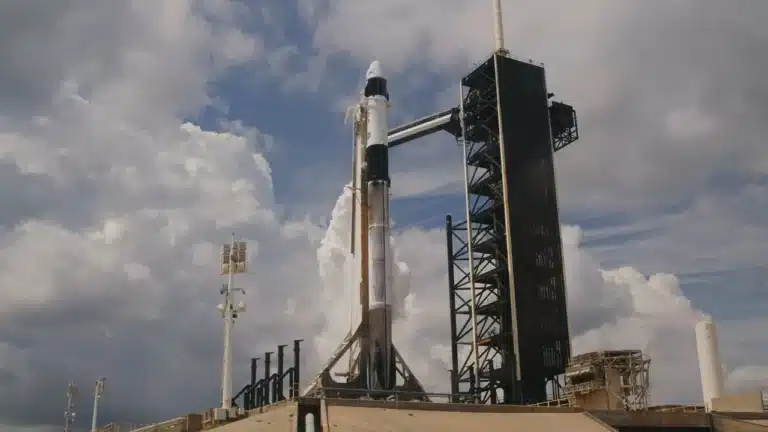
Named after the celestial body it’s traveling toward, mission probe Psyche launched in October 2023 from NASA’s Kennedy Space Center in Merritt Island, Florida, attached to SpaceX’s Falcon Heavy rocket. NASA foresees the Psyche probe reaching the asteroid—which some scientists are calling an early solar system planetesimal and other scientists are calling a shattered protoplanet—in mid-2029. (A planetesimal is a building block of other planets.)
As Space.com reported, Mars’ gravity will let the craft adjust its approach to Psyche, which is rich in metal and measures 173 miles across. Powered by a solar-electric propulsion system using xenon, an inert gas, the probe will travel 12,333 miles per hour on its own. But, as Universe Space Tech magazine described it, by coming uncommonly close to Mars’ surface, about 2,796 miles away, the probe will use the red planet’s gravity to create a cosmic slingshot effect, and gain speed while saving fuel.
Scientists have used this effect, called a gravitational maneuver or gravitational slingshot, in space missions for more than a half century. In 1959, Luna 3, a Soviet spacecraft, used lunar gravity to swing behind the moon for a far-side photograph. More recently, the effect figured in Pioneer 11’s trip toward Saturn, New Horizons’ trip toward Pluto, and Artemis II trip from the moon back to Earth.
Nautilus magazine said scientists have compared this slingshot effect with stones skipped across ponds. It follows Newton’s third law of motion: for every action, there’s an equal opposite reaction.
For the effect to work, angles matter. As Nautilus explained it, spacecraft that approach planets that are locked in their orbital paths will gain relative speed as gravity grabs them. Craft coming from the opposite direction, though, will lose speed. Bursts from the craft’s thrusters, called “burns,” push the craft through the slingshot and toward its next direction. A NASA operations team fired Psyche’s thrusters for 12 hours Feb. 23, 2026, to increase the probe’s speed and refine its Mars approach.
In general, the slingshot speed boost intensifies as the spacecraft gets deeper into the planet’s gravitational field. The field strength in relation to the craft’s position determines how much speed the effect adds. Stanford University’s Gravity Probe B blog said Jupiter’s greatest gravitational pull could add close to 100,000 miles per hour.
Although scientists haven’t enumerated just how much of a speed boost Psyche will gain, they’ve said the probe’s trip may not have happened without it. Space.com said using propulsion alone to achieve the same boost trajectory and speed shift would have required more propellent than the craft could realistically carry. It also would have added weight and made the launch pricier.
The craft will use a multispectral camera to take thousands of Mars images, which will let NASA calibrate optics and refine algorithms to help the probe traverse the target asteroid’s orbit in 2029. Arizona State University’ planetary scientist Jim Bell told NASA the probe will approach the asteroid at a large phase angle from Mars’ night side, gathering images of the planet as a crescent and using instruments to search for undiscovered moons.
Post-flyby, the probe will photograph the planet in its “full” phase. “The thin crescent on approach and the nearly ‘full Mars’ view after we fly past create opportunities for the imaging team for both great calibration observations as well as just plain beautiful photos,” Bell, who is based in Tempe, Arizona, told NASA.
NASA scientists already know billions of years of collisions with other space bodies have stripped off the asteroid’s surface, leaving an exposed nickel-iron core. In 2017, Psyche principal investigator Lindy Elkins-Tanton estimated the metals could be mind-bogglingly valuable, worth around $10,000 quadrillion, aka $10 quintillion. That’s a million trillion. (That would be about 11.9 million Elon Musk fortunes, if you take the high-end estimates of his net worth.)
But the scientists also hope to test theories, including that meteor fragments hitting Mars’ known moons, Deimos and Phobos, have created a dust ring, called a torus, around the planet. NASA’s mission team will use the agency’s Deep Space Network—an array of giant radio antennas in California, Spain, and Australia—to monitor radio frequency signals traveling to and from Psyche, noting Doppler shifts as the probe passes Mars. This way, when the probe leaves Mars’ orbit and ventures deeper into the asteroid belt, the team will know the probe’s speed and trajectory.
NASA said that by using a magnetometer, the probe will detect charged particles redirected from the sun; the probe’s gamma-ray and neutron spectrometer will track flux changes in cosmic rays. NASA will compare surface and atmospheric imaging and data from other Mars missions, by NASA (Reconnaissance orbiter, Mars Odyssey orbiter, and Curiosity and Perseverance rovers) and the European Space Agency to calibrate Psyche’s instruments. By synchronizing radio communications through the Deep Space Network, NASA can better plan for future Mars-approaching space missions.
Psyche’s cameras started producing raw images May 7, 2026. NASA scientists have said they hope to sequence future images to create a time-lapse video of the flyby. “This is our first opportunity in flight to calibrate Psyche’s imager with something bigger than a few pixels,” Sarah Bairstow, Psyche’s mission planning lead at NASA’s Jet Propulsion Laboratory in California, said in the Psyche blog.
Psyche, the craft, will spend two years examining Psyche, the asteroid. People who want to track the probe can do so on NASA’s Eyes on the Solar System front page.
***
Have a project on gravity that needs gravitas, or maybe a good grammar check? Nova Arc Content Co.’s crew can write, edit, proofread, or format it—or all of that and more. Schedule a meeting with us or check out our services.
SOURCES
- Burlaka, O. “The Psyche Mission Prepares For A Gravity Assist Maneuver Near Mars.” Published May 11, 2026.
- Callaway, K.R. “The Leader of NASA’s Psyche Mission Has Tips for Interplanetary Team Building.” Scientific American. Published May 9, 2026.
- Carter, J. “NASA’s Psyche Mission Faces New Mystery As It Nears Mars Flyby.” Forbes. Published March 27, 2026.
- Craig, J. “Psyche Mission Mars Flyby Event Added to Eyes On The Solar System Front Page.” NASA’s Eyes blog. Published May 14, 2026.
- Dunn, M. “It’s Time For Artemis II To Break Apollo 13’s Distance Record. What to Know About the Moon Flyby.” The Associated Press. Published April 5, 2026.
- Jet Propulsion Laboratory, NASA/California Institute of Technology. “NASA’s Psyche Mission to Fly by Mars for Gravity Assist.” Published May 8, 2026.
- Kuthunur, S. “NASA’s Psyche Spacecraft Is Flying to a Metal Asteroid. So, Why Did It Just Visit Mars?” Space.com. Published May 16, 2026.
- Lagatta, E. “Psyche Spacecraft Launched at Kennedy to Get Speed Boost from Mars.” Florida Today. Published May 15, 2026.
- Lea, R. “NASA’s Psyche Asteroid Probe Will Fly Within 3,000 Miles of Mars On May 15: Here’s What to Expect.” Space News. Published May 12, 2026.
- Metcalf, T. “The Slingshot Effect of Gravity.” Nautilus. Published January 28, 2025.
- Moon, M. “NASA’s Psyche Spacecraft Just Got An Assist From Mars on the Way to Its Asteroid Namesake.” Endgadget. Published May 16, 2026.
- NASA Glenn Research Center. “Newton’s Laws of Motion.” Cited May 18, 2026.
- NASA Psyche blog. “NASA’s Psyche Mission to Fly by Mars for Gravity Assist.” Published May 8, 2026.
- Odenwald, S. “Is There a Limit to How Fast You Can Go Using Gravitational Boosts From the Sun and Planets?” Stanford University Gravity Probe B blog. Cited May 18, 2026.
- Plait, P. “How Does a Gravitational Slingshot Work?” Scientific American. Published June 20, 2025.
- Space Center Houston. “Science in Action: Newton’s Third Law of Motion.” Published February 22, 2022.