NASA astronaut Christina Koch – NASA
Artemis II mission continues major progress for women in US space program.
When Artemis II flew around the moon in April 2026, mission specialist Christina Koch continued to make history for space exploration and for women.
With Artemis II, humans’ first moon visit in a quarter century, Koch became the first woman chosen for a US lunar mission and the first to travel deep space. She joined NASA commander Reid Wiseman, NASA pilot Victor Glover, and Canadian Space Agency mission specialist Jeremy Hansen on the crew. The trip aimed to set NASA up to make a moon landing by 2028 and a moon base by 2036. (US astronauts last landed on the moon with Apollo 17 in 1972.)
Koch’s feat continued a six-decade run in which women went from being shut out of US space travel to gaining ground toward more equal footing with their male counterparts.
“Decades ago, we made the right decisions so that our astronaut corps brings diverse backgrounds together to solve the hardest problems,” Koch told Space magazine after Artemis II returned to Earth. “And that, to me, is what’s truly worth celebrating, and what I’m honored to be a part of.”
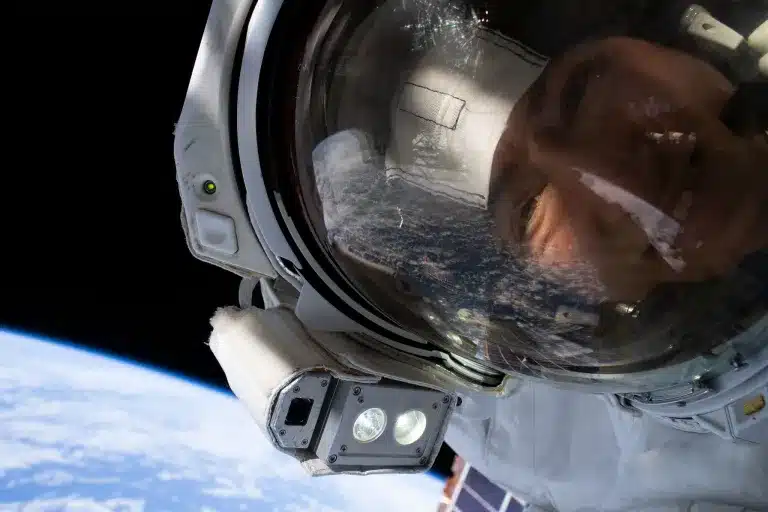
The mission let Koch, a physicist and electrical engineer, lengthen a record-setting space résumé. She’s been part of three NASA all-female spacewalks; the first came in 2019 alongside fellow NASA astronaut Jessica Meir. Also in 2019, Koch set the record for the longest single continuous spaceflight by a woman, spending 328 days aboard the International Space Station.
On International Women’s Day, the World Economic Forum reported that 60% of NASA’s latest astronaut candidate class is female, 15 of 38 active NASA astronauts are female, and that six women comprise “the next generation of American explorers,” along with four men.
In another nod to US women’s progress in space, Artemis II featured spacesuits with more sizes and adjustability, partly to suit female astronauts. In 2019, having only one medium-sized spacesuit available canceled the first all-women spacewalk from the International Space Station. Anticipating long space missions for women, scientists have begun researching methods that support women astronauts who chose to continue menstruating (and not use hormonal birth control) while on missions.
Beyond the US, France’s Sophie Adenot joined the International Space Station crew, one of three women in the European Space Agency’s 11 active astronauts. The group’s 12-member reserve astronaut pool had six women.
A look back into the recent past shows how far US women’s space progress has come. Soviet astronaut Valentina Tereshkova became the first woman to travel in space in 1963, completing a three-day solo mission aboard Vostok 6. The United States’ immediate response? A plastic proxy. With the space race at fever pitch in 1965, Mattel released an Astronaut Barbie. But until the 1970s, only US men were permitted to be astronauts. To start, all US astronauts had been armed forces test pilots; NASA changed the astronaut requirements in the 1960s to allow scientists—but only male ones.
In a 1962 letter, a NASA official acknowledged that women held important scientific jobs in the US space program. But he wrote, “We have no present plans to employ women on spaceflights because of the degree of scientific and flight training, and the physical characteristics, which are required.” (The official was answering Linda Halpern, an elementary school student who, to fulfill a school assignment about pursuing a dream, had written to President John F. Kennedy.)
Alice George, a historian who authored a book about US women’s history in spaceflight, wrote in the Smithsonian magazine that women who would become the first US astronauts were undeterred. Though they had no spaceflight role models, they shared a passion for science. “Those who thought about being an astronaut thought, ‘Someday, NASA may have women astronauts, and I want to be ready,’” George wrote.
In 1978, 20 years after NASA’s creation, the US astronaut corps diversified, adding six women, along with three Black men and an Asian American man. The women in the first cohort included Sally Ride— who, in 1983, would become the first American woman in space—Judith Resnik, Kathryn Sullivan, Anna Lee Fisher, Margaret Rhea Seddon, and Shannon Lucid.
From 1978 through 2018, the US’ astronaut corps added 57 women, including Eileen Collins, Mae Jemison, and Peggy Whitson. Smithsonian magazine noted that the women added to the late 1970s US astronaut corps demanded the same training and treatment as the men. In 1983, Ride became the first US woman (and the youngest person) in space. And slow progress was made. In 1984, Sullivan, an oceanographer, became the first US woman to walk in space and the first to wear the shuttle-era spacesuit, a 225-pound extravehicular mobility unit (EMU). She’d fly three shuttle missions and log 532 hours in space.
In 1992, Jemison, a physician and engineer, became the first Black female US astronaut when she joined a research mission. Five more Black women followed in space missions. From 1995–2005, Collins, of the US Air Force, was the first US woman to pilot and command a space shuttle; she flew on four space shuttle missions, piloting two and commanding two.
Whitson, meanwhile, became the International Space Station’s first female commander and holds the record among all American astronauts for the most time spent in space: 695 days. Her 10 career spacewalks, which lasted a collective 60 hours, 21 minutes, set a record for female astronauts. Whitson is now human spaceflight director for Texas-based Axiom Space, which hopes to establish privately owned space stations by the time the International Space Station decommissions in 2030.
At the 2026 World Economic Forum in Davos, Italian astronaut Samantha Cristoforetti, the first European woman to command the International Space Station, said the astronaut pipeline has changed as more women have been enabled to pursue science, technology, engineering, and mathematics (STEM) careers.
“I became an astronaut 15 years ago, and, back then, in that era, female astronauts were definitely still a minority. But boy, it has changed in the last 15 years. I mean, the last selections, both with NASA and with [the European Space Agency], are pretty much a 50-50 split.”
Each step forward is cause for celebration…and, for many women and others from marginalized communities, a stark reminder of how far there is yet to go. In 1983, at a press conference before she flew aboard the Challenger space shuttle, Ride said, “It’s too bad this is such a big deal. It’s too bad our society isn’t further along.” She was right. Since then, we’ve seen strides forward, encouraging more women and others from marginalized communities to find and make their place in space, in exploration, and in history. And now her words can serve as a reminder of how far we’ve come and how empowered we are to do even better in the future.
***
As a woman-owned business focused on content in STEM, defense, and aerospace, Nova Arc is a strong and vocal supporter of equality for all in these spaces. We’re uniquely positioned to understand both the technical aspects of the content and the far-reaching social and cultural implications that happen alongside impressive, impactful progress. We’re ready to partner with you on writing, editing, proofreading, and consulting for projects moving progress forward. Arrange a meeting to hear about our services.
SOURCES
-
- Anderson, A. “Sally Ride.” National Women’s History Museum. Published 2018.
-
- Britannica. “Peggy Whitson Biography.” Cited April 22, 2026.
-
- CBBC. “NASA Reveals New Astronauts for Moon and Mars Missions.” Published September 23, 2023.
-
- Coelho, L., Miranda, C., Canas, J., Morgado, M. Nunes, D., Henriques A., and Langeveld, A. “One Giant Leap for Womankind: First Menstrual Cups Tested in Spaceflight Conditions.” NPJ Women’s Health. Published December 2, 2025.
-
- Dinner, J. and Howell, E. “‘An Incredible Privilege and Responsibility’: Artemis 2’s Christina Koch Is Ready to Become the 1st woman to Fly Around the Moon.” Space. Published March 29, 2026.
-
- Dunn, M. “Artemis II’s Record-Breaking Journey Around the Moon Ends with Dramatic Splashdown.” The Associated Press. Published April 11, 2026.
-
- Edwards, B. “With Artemis II, Astronaut Duo Sees Out-of-This-World Female Friendship.” Published March 27, 2026.
-
- George, A. “How Far American Women Astronauts Have Soared Since Sally Ride Took Her Historic Spaceflight.” Smithsonian magazine. Published October 28, 2025.
-
- Guinness World Records. “Peggy Whitson: Most Spacewalks by a Female.” Cited April 22, 2026.
-
- National Space and Aeronautics Administration. “Kathryn D. Sullivan Bio.” Cited April 23, 2026.
-
- Neal, A. “America’s First Spacewalking Woman: Kathryn D. Sullivan.” National Air and Space Museum. Published October 14, 2014.
-
- Neidl, P. “From the Ocean to Outer Space: The Adventures of Dr. Kathy Sullivan.” Rolling Stone. Published March 3, 2021.
-
- Reuters. “Artemis II Crew Includes First Woman, Black Astronaut and Canadian Ever Flown to Moon.” Published April 1, 2026.
-
- Rincon, P. “Christina Koch: NASA Astronaut Sets New Female Space Record.” BBC. Published February 6, 2020.
-
- Rummler, O. “Women Made History in Space Long Before the Blue Origin Flight.” The 19th. Published April 24, 2025.
-
- Smithsonian. “A Woman’s Place: Outer Space.” Published September 8, 2025.
-
- United Nations Office of Outer Space Affairs. “Space for Women: Landmark Study on Gender Equality in the Global Space Sector. Phase 2.” Published October 2025.
-
- Wainscott-Sargent, J. “Peggy Whitson Opens AIAA SciTech Forum, Celebrating ISS Era and the Transition to Commercial Space Stations.” Aerospace America. Published January 12, 2026.
-
- Weitekamp, M.A. “NASA’s Early Stand on Women Astronauts: “No Present Plans to Include Women on Space Flights.” National Air and Space Museum. Published March 16, 2016.
- World Economic Forum. “International Women’s Day: What NASA’s latest astronaut picks tell us about gender equality.” Published March 11, 2026.
- Weitekamp, M.A. “NASA’s Early Stand on Women Astronauts: “No Present Plans to Include Women on Space Flights.” National Air and Space Museum. Published March 16, 2016.