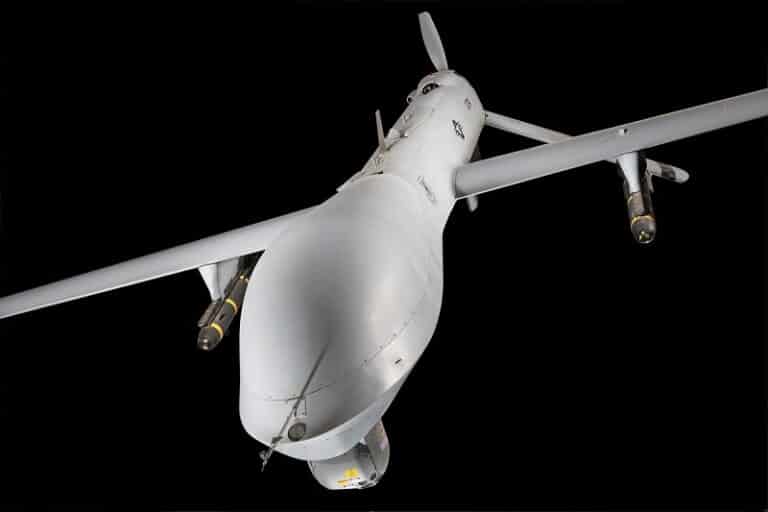
General Atomics Aeronautical Systems, Inc., MQ-1L Predator A (A20040180000), Smithsonian Air and Space Museum, Washington D.C.
For drones, history began with not a feature, but a bug.
In 1913, American inventor Elmer Sperry, aided by his son Lawrence and funded by the US Navy, developed an automatic gyrostabilizer that allowed straight, level flight by a Curtiss flying boat unaided by any onboard human pilot. The breakthrough addressed a stubborn problem in early aviation: keeping craft stable without constant correction by a human.
Then, in 1917, inventor Charles F. Kettering designed the Kettering Bug, an uncrewed torpedo for the US Army Signal Corps, which intended to use it to send explosives toward enemy targets during World War I. Launched from a four-wheeled dolly and stabilized by pneumatic and electrical controls, the Bug could fly up to 50 miles per hour and hit ground targets up to 75 miles from its launch point, letting it act as an uncrewed long-range torpedo. Although the Bug’s range was remarkable, its reliability was, well, buggy, so the US Army never used it in combat.
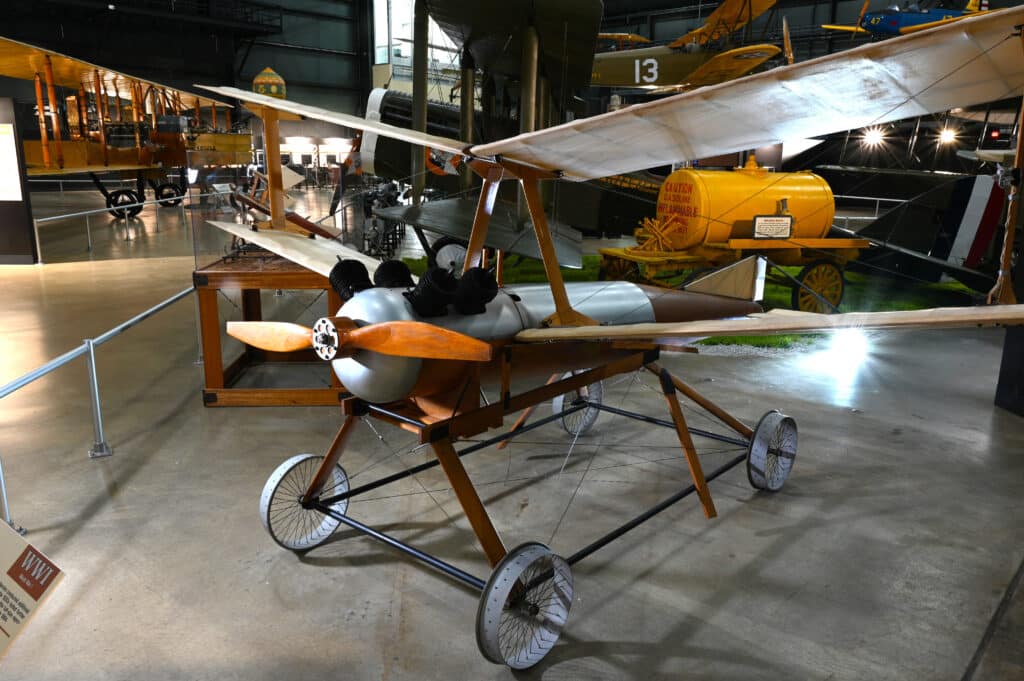
Kettering Bug Drone – Air Force Public Photo
In the 1930s, British military leaders, frustrated by naval antiaircraft gunners’ failure to hit quick-turning enemy aircraft, developed the de Havilland Queen Bee, a drone with an enclosed rear flight deck packing radio-control gear. The Queen Bee was first piloted by people, but then driven remotely; the first uncrewed flight came in 1935.
And then came drones from the assembly line. Former British Royal Air Force pilot Reginald Denny took drones a step further through mass production. After emigrating to the US and acting in Hollywood, Denny added radio control to model planes and sold the gadgets first to hobbyists, then to the armed forces. By 1937, Denny was developing radio-controlled Radioplane drones for the US Army. In 1939, Radioplane OQ-2 became the US’ first mass-produced UAV, according to the National Air and Space Museum. The follow-up OQ-3 became US forces’ most widely used target drone; more than 9,400 OQ-3s were built during World War II.
Gyrodyne QH-50s, helicopters that emerged during the Cold War, were one of the first armed uncrewed aerial vehicles. And during the Vietnam War, the US used some Gyrodyne QH-50s to spot naval gunfire and AQM-34 Ryan Firebees, jet-powered target drones, to target surface-to-air missiles and run stealth surveillance.
In the 1980s, Israeli Defense Forces used small, quiet drones with infrared cameras and target designators, which foreran today’s UAVs. The US bought or produced those early models under license. Then, in 1995, the US started using its first UAV model, the MQ-1 Predator, a predecessor of the modern US Air Force’s MQ-9 Reaper, a $28 million “hunter-killer” UAV that can travel up to 300 mph, collect information and conduct surveillance.
The Emerging Importance of Modern Drones
Wherever drones can work, nations and their militaries now want them. In September 2025, European Commission President Ursula von der Leyenca recommended that the European Union build a “drone wall” as “the bedrock of credible defense.” In June 2025, US President Donald Trump issued “Unleashing American Drone Dominance,” an executive order urging faster U.S. drone development for military and commercial use and requesting measures to mitigate drone-related threats to national security and public safety. “This not tomorrow’s problem,” US Army Maj. Gen. Curt Taylor told CNN, describing drones. “This is today’s problem.”
Trump also directed the US Federal Aviation Administration (FAA) to loosen rules to let routine drones fly beyond the “visual line of sight” for goods-and-services deliveries over wider distances. US Defense Secretary Pete Hegseth has issued two major drone memos since Trump’s order. One memo, issued in July 2025, called to loosen standards for operating or procuring drones and to classify the smallest drones as “consumable commodities,” akin to ammunition. The other memo, issued in December 2025, urged US drone makers to manufacture 300,000 low-cost attack drones.
Commercially, the US FAA says most people can now fly drones as recreational flyers, under the Small UAS Rule and after passing a basic safety knowledge test. In general, the drones must stay lower than 400 feet, stay in the human operator’s sight, avoid other aircraft, and spare other people and property injury. Flying drones for newsgathering or videography requires a drone pilot certificate.
The Future of Commercial Drones
The first delivery drone, the Flirtey’s F3.0 hexacopter, completed its mission July 17, 2015, carrying emergency medical supplies to the Wise, Virginia, Remote Area Medical Clinic. Today, drone deliveries are becoming common in many cities, with projections they’ll continue to become a greater force in commerce.
Walmart and Wing, owned by Google parent Alphabet, plan to expand a program delivering goods from 18 Dallas-area Walmart stores to 100 stories in Atlanta, Houston, Charlotte, Orlando, and Tampa by summer 2026. In August 2025, the US FAA proposed a new rule to make it easier for companies to fly drones outside of an operator’s line of sight and therefore over longer distances. A few companies already do this, but were required to obtain waivers and air carrier certification to deliver packages. Grand View Research, a San Francisco market research and consulting company serving Fortune 500 companies, estimated the US drone market will reach $163.6 billion by 2030 and will have a compound annual growth rate of 14.3% from 2025 to 2030. The US FAA has forecast that the fleet of business-connected drones in the United States will reach 955,000 by 2027. In 2020, Dronegenuity, a Hudson, Massachusetts, professional drone services provider, estimated drones had figured in 218 ways in US commerce. Drone duties the company listed include restaurant, poolside, and golf courses waiter; bar drink shakers; blood, vaccine, and hospital organ deliverer; pest controller; instant replay assistant for sports; and traffic director.
Amazon aims to deliver 500 million packages drone annually by the end of 2030, and US News & World Report listed Amazon among its top drone-related stock picks for 2026. So far, reports New York-based market research digital marketing and media company Emarketer, current economics favor drones for delivering low-weight items (5 pounds or less) for short distances (less than 6 miles).
On the Battlefront
As civilian drones are moving toward commercial use, military investment in them continues to accelerate. Business Insider reported the Pentagon will invest $13.4 billion in autonomous systems in fiscal 2026, including $9.4 billion on aerial combat drones. Also, the report said, the US Air Force has requested $789.4 million to research and develop autonomous “loyal wingmen” drones that can fly and fight alongside crewed combat aircraft or complete missions solo.
Nevertheless, Justin Bronk, a senior military sciences research fellow at the Royal United Services Institute think tank, argued that although drones have altered ground combat, they may matter less in maritime defense. In a Dec. 15 article in Foreign Affairs, Bronk wrote that although drone support helped the Ukrainian and Russian armies push through fixed defensive lines, ranges for fiber-optic-cable-equipped first-person view drones top out near 15 miles. So, he argued, uncrewed systems wouldn’t help US Air Force and Navy personnel offer air cover or sea support in an Indo-Pacific conflict, such as one involving Taiwan and China.
“Even if small drones could be delivered rapidly across the required ranges,” Bronk wrote, “none of the varieties currently in use in Ukraine by either side could effectively defend U.S. forces against Chinese attacks.…Small drones simply cannot intercept combat aircraft operating at high altitudes and speeds.”
***
Need a historical look at a trending topic written for you? Or a paper explaining something technical? Nova Arc specializes in writing, editing, proofreading, and promoting these projects. Contact us here.
Sources
- Clark, P. A. and editors. “FAQ on Drone Delivery: What Retailers Need to Know in 2026.” Emarketer. Published January 27, 2026.
- De Havilland Aircraft Museum. “de Havilland DH82B Queen Bee.” Cited December 10, 2025.
- Durbin, D. “Delivery Drones May Soon Take Off in the US. Here’s Why.” The Associated Press. Published August 12, 2025.
- Federal Aviation Administration. “What to Know About Drones.” Published January 14, 2025.
- Government Accountability Office. “Drone Operations.” Cited February 16, 2026.
- Grand View Research. “Drone Market (2025-2030).” Cited February 16, 2026.
- Imperial War Museum. “A Brief History of Drones.” Cited December 11, 2025.
- Imperial War Museum. “How the MQ-1 Predator Redefined Aerial Warfare.” Cited December 11, 2025.
- Lewis, D. “The First Delivery Drone in the United States Lands a Spot at the Smithsonian.” Smithsonian Magazine. Published May 2, 2016.
- Marino, C. “Send in the Drones.” US Army, Published October 17, 2024.
- McKinnon, G. D. “The Birth of a Drone Nation: American Unmanned Aerial Vehicles Since 1917.” Master’s thesis, Louisiana State University. Published August 2014.
- Muller, J. “Drones Will Soon Be Everywhere, as U.S. Seeks to Lead Future of Aviation.” Axios. Published June 11, 2025.
- O’Connell, B. “7 Best Drone Stocks to Buy for 2026.” US News & World Report. Published February 5, 2026.
- Panella, C. “America’s Biggest Defense Contractors Are Fighting for Their Place in the Future of Drone Warfare.” Business Insider. Published December 5, 2025.
- Piesing, M. “The Secret History of Drones.” Air & Space Quarterly. National Air and Space Museum. Published September 23, 2024.
- Pozner, J. “A Comprehensive List of Commercial Drone Use Cases (128+ and Growing).” Dronegenuity. Published June 18, 2020.
- Roblin, S. “New Defense Department Policy: “Unleashing” Small Drones, Cutting Regulations.” Inside Unmanned Systems. Published July 14, 2025.
- Schaper, D. “Drone Delivery Is One Step Closer to Reality.” NPR. Published October 18, 2019.
- Shepardson, D. “US Proposes New Drone Rules that Could Lead to Starbucks, Amazon Deliveries.” Reuters. Published August 5, 2025.
- Smith, J. “Does Europe Need a Drone Wall?” Chicago Council of Global Affairs. Published November 18, 2025.
- Tagami, T. “Some Georgia Walmart Stores Piloting Drone Delivery This Holiday Season.” Savannah Morning News. Published December 4, 2025.
- Wing. “Wing and Walmart Announce World’s Largest Drone Delivery Expansion.” Published June 5, 2025.